“Small businesses operate in a world in which there is neither market-generated protection from competition nor regulatory protection,” laments Adam J. Levitin, J.D., in a paper outlining market and regulatory failures published by the Yale Journal on Regulation. But you don’t need to read his full 71-page document to understand that traditional lenders have left a major funding gap for small and mid-sized business owners—one predatory lenders have been all too eager to fill. With little external protection available, spotting predatory lending red flags is key to avoiding becoming a victim. We’ll walk you through what to look for, how to avoid predatory loans, alternatives to predatory lending, and what to do if you’re already trapped, below.
What is Predatory Lending?
Predatory lending refers to any unfair, deceptive, or abusive lending or financing practice that benefits the lender while exploiting, harming, or trapping the borrower.
While the consumer market has robust federal protections against predatory lending, the commercial market has been slow to catch up. Regulations are few and fragmented, often leaving states to carve out their own paths. Because of these limited regulations, reduced access to financing, and the increased prevalence of predatory lenders driven by the online lending boom, small businesses and startups face a greater risk of falling victim to predatory lending practices.
Common Predatory Lending Practices in the Commercial Market
Before we dig into the predatory lending red flags, let’s take a look at the practices predatory lenders use that make securing funding through them so dangerous.
Disguising the True Cost to Borrow
In the consumer market, the Truth in Lending Act (TILA) requires lenders to clearly disclose key terms before extending credit, including the annual percentage rate (APR), finance charge, amount financed, total payments, and payment schedule. There’s no equivalent federal disclosure requirement for most commercial financing, so predatory lenders often hide fees and don’t disclose what you’ll pay over the life of the loan. Instead, they shift your focus to accessibility or individual payments, which can make a funding product seem affordable even when the total cost is astronomical.
Daily or Weekly Repayments
Frequent payments are one tactic that predatory lenders use to disguise the true borrowing cost. For instance, the funding provider may hold back a portion of your credit card sales every day as a form of repayment or take weekly payments toward the debt. In one recent case, seemingly manageable daily withdrawals masked annual interest rates up to 820 percent, the Office of the New York Attorney General reports.
Creating Debt Cycles That Trap the Business
Arguably, the most pervasive predatory lending practice is the intentional cycling of debt. Whether through sheer ignorance of your financial situation or the prioritization of their profit over your financial health, predatory lenders routinely structure repayment in a way that forces you to take out another loan or renew your current one, trapping you in a cycle of debt that’s incredibly difficult to escape.
Abusing Collection Access
While many legitimate lending companies offer automated payments as a matter of convenience and to help keep repayment on track, predatory lenders often abuse this access. They may withdraw more than agreed upon, accelerate repayment, or increase the frequency of payments. Adding to this, many have a list of requirements to get your money back. These lists are designed to make the process virtually impossible, which can unexpectedly drain a business’s finances and make cash flow management difficult.
Bait-and-Switch Tactics
Virtually all funding companies have an underwriting process in which they assess your financial position and identify terms that align with the level of risk they’re assuming. It’s not abnormal for your final offer to differ slightly from what you saw or read prior to applying. However, predatory lenders may lure you in with offers they have no intention of honoring, then push a completely different product or terms after you’ve already jumped through all their application hoops.
Asset Stripping and Ignoring Ability to Pay
One major contributing factor to the 2008 financial crisis was homeowners receiving mortgages they couldn’t afford. Lenders used the homes as collateral and created loans where only interest was due at first, or where interest rates jumped after a certain number of years. When homeowners predictably couldn’t keep up with payments later, lenders took the home. Federal ability-to-repay rules later required lenders to assess whether borrowers could reasonably repay most consumer mortgages, but business loans generally aren’t covered by those rules. Predatory lenders may exploit that gap by extending unaffordable financing with the aim of seizing valuable business assets when the borrower defaults.
Loan Packing
Loan packing, also known as payment packing, is the practice of stuffing unwanted insurance policies, service contracts, or high-fee financial add-ons into a loan or financing agreement without the borrower’s clear consent. The fees increase your total costs and make it harder to pay off the balance.
10 Predatory Lending Red Flags for Businesses

You now know what’s happening beneath the surface with predatory lenders, but shady practices often stay hidden until after you sign an agreement. It’s essential to watch for predatory lending red flags before you’re trapped. Below, we’ll explore some of the warning signs you might be able to spot ahead of time. Although they’re not proof that you’re dealing with a predatory lender on their own, spotting them is a sign to pause and investigate further.
1. Guaranteed Approval
Legitimate funding providers need to assess your business before they can tell you if you qualify. If someone guarantees approval before reviewing your financial situation, they may be more interested in getting you to sign than making sure you can afford the financing. Some use the promise to draw you in, then demand upfront fees or push funding with terms that put your business at risk.
2. Unnecessary Urgency or Pressure to Sign Immediately
Predatory lenders don’t want you to examine their terms too closely or compare offers. They may tell you an offer expires today or pressure you to sign before they’ve answered all your questions. If someone insists you need to commit before you’ve had time to understand the agreement, take a step back and consider what they’re trying to rush you past.
3. Unsolicited Offers with Unverifiable Claims
An unsolicited funding offer isn’t necessarily a sign of predatory lending, but you should be able to verify who’s contacting you and what they’re promising. Be wary if someone claims you’ve been preapproved without knowing anything about your business or says they’re affiliated with a bank or government program you can’t confirm. If their claims don’t hold up when you check independently, don’t give them access to your financial information.
4. Rates that Obscure the Annualized Cost
As touched on earlier, predatory lenders often disguise the true cost of borrowing. Watch for offers that advertise “simple” interest or factor rates without showing the APR. Ask the provider to explain what you’ll pay on an annualized basis, including fees. If they dodge the question or push you to focus only on the payment amount, there’s probably a reason they don’t want you looking at the full cost.
5. Excessively High Financing Costs
You should expect to pay more for financing if your business presents a greater risk, and added services or flexibility can justify a higher price. But predatory lenders may charge astronomical rates simply because they know you’re short on options. Get quotes from other funding providers and compare both the costs and what’s included. If one company is charging substantially more, ask what accounts for the difference. You may find that the convenience they’re selling comes at a price your business can’t afford. Equally, you may find that the one that looks more affordable upfront shortchanges you on service or hides costs.
6. Fees that Appear Late in the Process
You may get through most of the application process before a funding provider mentions an origination fee, processing charge, or other cost. By then, you’ve invested time and may be counting on the money, making it harder to walk away. Ask for a full breakdown of fees early on. If new charges keep appearing or the provider dismisses them as something you don’t need to worry about, pause before signing.
7. Repayments Your Cash Flow Can’t Support
A legitimate funding provider should review your cash flow to assess whether you can afford repayment, and you should run the numbers yourself too. Are you basing your ability to repay on what your business generates now, or counting on sales growth, a big contract, or refinancing later? Be sure to run a cash flow stress test. If repayment only works when everything goes according to plan, you could be setting yourself up for trouble. Be wary of a lender who skips this review or encourages you to borrow based on income you haven’t secured yet.
8. Short Repayment Windows with Fluctuating and Frequent Payments
Many predatory lenders have exceptionally short repayment windows, such as 60 to 90 days. While this isn’t inherently bad if you’re genuinely in a position to pay off the balance quickly, windows are often kept intentionally short to trigger you to pay more fees and renew the term.
Some predatory lenders also agree to accept a percentage of your sales. It’s presented as a positive thing that your payments line up with revenue. However, if your cash inflows don’t align with your expectations, you may wind up with even less cash to cover your expenses than planned. This often serves as a second trigger event. Businesses take out more funding, defer repayment, or renew because they’re left with too little cash on hand. Costs climb even more.
This is the vicious cycle people often discuss in terms of predatory lending and credit card debt. The loan itself becomes a barrier to covering your expenses and growing. The more debt you take on or the longer it stretches on, the harder it is to climb out of the hole.
9. Unclear or Contradictory Paperwork
What the funding provider promises should match what’s in your agreement. If they tell you payments will adjust with revenue, but the paperwork requires fixed withdrawals, ask them to explain the discrepancy and correct it before you sign. The same goes for missing fees, unexplained terms, or conflicting repayment schedules. Be wary if they dismiss your concerns with “that’s just standard paperwork” or assure you they’ll honor a promise they won’t put in writing.
10. Costly or Unclear Early Payoff Terms
You might expect paying off your financing early to save you money, but some agreements require you to pay all the financing charges regardless of when you settle the balance. Others add a prepayment penalty, making it more expensive to get out of the agreement. Ask the provider what you’d owe if you paid early and how that amount is calculated. If they promise savings but won’t explain them in writing, or you can’t determine what it would cost to leave, investigate before signing.
Predatory Lending Examples
One of the most common examples of predatory lending is payday loans in the consumer market. Although not all payday loans are predatory, they often come with high costs, and lenders generally require access to your bank account, allowing them to attempt withdrawals even if your paycheck doesn’t arrive on time. Borrowers routinely report getting hit with non-sufficient funds (NSF) charges as a result, and many renew their terms repeatedly. In business, we see similar predatory practices with a few specific types of funding.
Merchant Cash Advances
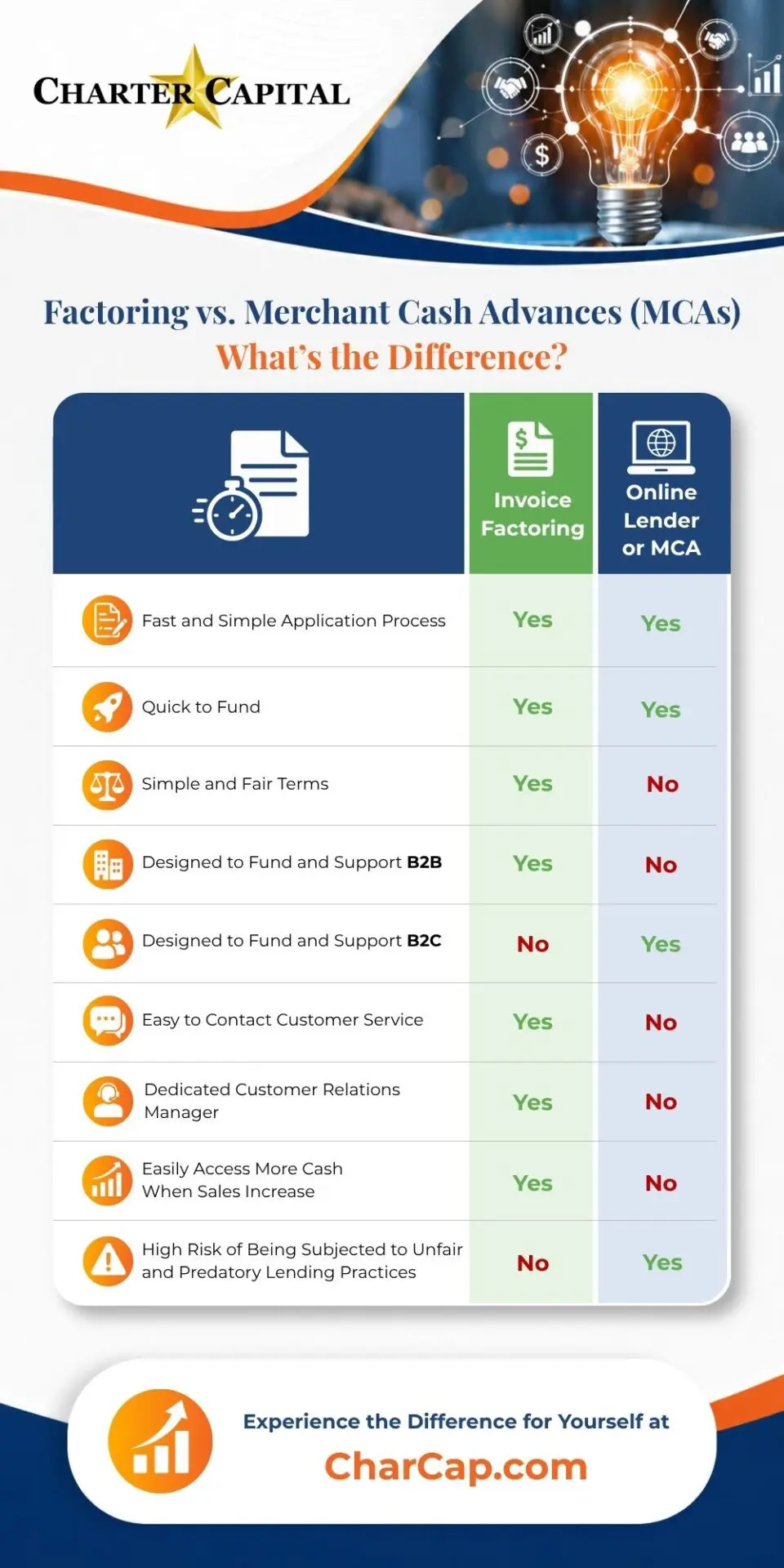
With merchant cash advances (MCAs), the MCA company purchases a portion of your future sales for an upfront lump sum.
This may sound ideal on the surface, but they don’t use standard interest rates. Instead, they use a factor rate, such as 1.2 to 1.5, that can translate to triple-digit effective APRs, combined with daily or weekly automated clearing house (ACH) withdrawals or holdbacks from your credit card sales that destroy cash flow.
This is what the New York Attorney General’s office was addressing when it took down lenders charging 820 percent interest. One of the businesses involved got trapped in a debt cycle with an MCA provider where payments eventually reached $2,000 a day. Despite having dozens of employees and nearly 30 years in business, the borrower couldn’t shoulder the payments and closed.
MCAs have also been the target of recent legislation here in Texas. The new laws invalidate clauses that allow pre-made confessions of judgment, which let MCA providers obtain a judgment against a borrower in court without notice of a hearing if the borrower fails to make payments under the contract terms. MCA contracts for financing under $1 million must now also disclose certain figures, such as the total finance charge, total repayment amount, and extra fees. These laws, however, do not set a cap on fees or APRs for Texas borrowers, so small businesses must stay vigilant when reviewing documentation.
Short-Term Online Business Loans
Some online lenders market “fast, no-hassle” working capital loans with minimal underwriting or credit checks. However, predatory lenders offering these loans pack hidden origination fees, heavy administrative charges, and short repayment timelines into contracts that push effective interest rates past 50 or even 100 percent.
It’s worth noting that even outside of clear cases of predatory lending, online loans can be expensive: 60 percent of small businesses that obtain them report higher-than-expected borrowing costs, per the latest Small Business Credit Survey.
Loan Refinancing
Other predatory lenders target businesses struggling to make payments and pressure them to refinance or roll over the balance into a new loan. Unfortunately, each iteration can roll old principal, interest, and steep new “processing fees” into a larger debt, trapping the business in an escalating cycle of leverage.
Equipment Leasing and Financing Brokers
Some brokers offer seemingly low monthly payments for machinery, POS terminals, or vehicles. It sounds ideal on the surface, but they bury hidden balloon payments, exorbitant prepayment penalties, and non-cancellable clauses that make it impossible to exit the lease without paying massive fees
How to Avoid Predatory Lending as a Small Business
Knowing how to avoid predatory lending practices involves more than spotting red flags. Use a few additional best practices to further safeguard your finances.
Convert Everything to an APR
Always translate factor rates or flat fees into a true APR that includes fees. This will give you a clearer picture of what you’re paying to borrow and allow you to compare offers with more accuracy.
Shop Around and Compare Quotes
Obtain written quotes from at least three different financial institutions before deciding. Try to secure them from different types of lenders from our alternatives list covered in a later section below.
Verify the Lender
Check with your state banking regulator to confirm whether the provider needs a license or registration and whether it has one. Review complaints and enforcement actions through your state attorney general’s office and the Better Business Bureau (BBB).
Consult Trusted Advisors
Have your CPA or business attorney review the loan agreement, disclosure forms, and repayment schedule prior to signing anything.
Beware of MCAs
Be cautious of MCAs that take daily or weekly payments from your revenue. Check how much cash the withdrawals will leave for operating expenses and whether promised payment adjustments are actually available when sales decline.
How to Get Out of a Predatory Loan
Are you now wondering: “Am I a victim of predatory lending?” Chances are, if you’re questioning it, you’re not getting a particularly good deal even if you’re not specifically dealing with a predatory lender. Either way, there are things you can do about it.
Step 1: Get Help Protecting Your Operating Cash
If loan repayments are sinking your business and you can’t keep up with them, the first step is usually to stop them. There are consequences for doing this, so talk to your financial advisor before you make a move. If you’re unsure, evaluate the other steps first.
- Revoke ACH/POS Authorizations: Many predatory small business lenders and MCAs pull funds directly from your bank account or point-of-sale (POS) system daily or weekly. Ask your attorney and bank whether unauthorized or excessive withdrawals can be blocked, what notices are required, and how stopping payments would affect your agreement.
- Expect Aggressive Contact: Once you block payments, the lender or collection agency will likely call frequently or threaten default. Stay calm and direct all communications to writing or to legal counsel.
Step 2: Audit the Contract and Terms
Get clarity on what you signed and what your current position is.
- Calculate the Financing Cost and Remaining Balance: Calculate the APR or estimated APR, including fees, and reconcile the provider’s claimed balance against the agreement and your payment records.
- Look for Personal Guarantees and UCC Liens: Check whether you signed a personal guarantee or if the lender placed a UCC-1 blanket lien on your business assets.
- Check State-Level Protections: Federal TILA protections often exclude commercial loans, but many states have laws against usury, unlicensed lending, or deceptive trade practices that may provide grounds to challenge the agreement or its enforcement.
Step 3: Negotiate or Refinance Safely
Next, identify which exit plans are available to you and move away from the predatory lender.
- Negotiate a Settlement: A business debt attorney may be able to negotiate a reduced lump-sum payoff or a restructuring plan with payments your business can afford. Get any agreement in writing, including how the settlement affects personal guarantees, liens, and the remaining balance.
- Refinance with a Reputable Institution: If your credit and cash flow allow, work with a safe lender to consolidate high-cost debt into a lower-rate term loan. Beware of loan flipping or refinancing schemes, where a predatory lender offers to refinance you into an even more expensive trap.
Step 4: Explore Legal or Restructuring Options
Escalate the issue if you feel it’s appropriate to do so.
- Consult a Business Debt Attorney: An attorney can evaluate whether the lender is properly licensed in your state, challenge out-of-state confessions of judgment or aggressive enforcement, and negotiate a release of UCC liens.
- Consider Formal Restructuring: If the debt has crippled your operations and the lender refuses to negotiate, look into formal business restructuring or bankruptcy protections with legal guidance.
- Report the Lender: File a complaint regarding deceptive or fraudulent business lending practices with your state’s Attorney General.
Safer Alternatives to Working with a Predatory Lender
Many predatory lenders include clauses in their contracts that make it difficult or impossible to move to another lender, so the best approach is to work with a safe lender from the start.
Traditional and Community Banks or Credit Unions
It’s much harder to qualify for funding with a traditional lender than an alternative lender. The process is usually much slower too: think in terms of weeks or months versus days. However, they typically offer transparent rates and fair terms.
SBA Loans
Backed by the Small Business Administration (SBA), SBA loans offer capped interest rates and longer repayment windows. These also have rigid requirements and can take a while to process, so they work better when they’re used for planned expenses.
Community Development Financial Institution Loans
Community development financial institutions (CDFIs) are designed to help small businesses and under-resourced owners with fair financing and counseling. While they can sometimes be more flexible than traditional lenders or SBA lenders, and don’t always weigh your credit score as heavily, they’re more likely to scrutinize your business plans, financials, and potential social impact.
Invoice Factoring
Invoice factoring, sometimes called accounts receivable factoring or factoring, provides you with funding in exchange for your open business-to-business (B2B) invoices. It’s based on work you already completed and unpaid B2B invoices you’ve already issued, unlike MCAs that are based on a prediction or forecast of future sales or future credit card/bank deposits.
You receive most of the value of your invoice up front. When the payment is due, your customer pays the factoring company, or factor, directly, similar to the way outsourced billing works. You receive the residual after your customer pays. As a result, there’s no debt to pay back. Not only does this help businesses prevent the debt spiral that comes with other forms of funding, but many businesses report improved financial health because cash flow becomes more predictable and it’s often easier to keep up with vendor payments.
This unique approach makes it much easier to qualify for than traditional forms of funding. If you have B2B customers and a history of invoicing them with reliable payments on their end, you’ll likely qualify. Plus, approval is fast, and you can usually receive your funding within a day or two.
With that being said, factoring isn’t an option for all businesses that might otherwise choose MCAs. Whereas MCAs are more often used by business-to-consumer (B2C) companies and typically rely on your credit and debit card sales, factoring is designed for B2B industries. For that reason, it’s a good fit for trucking companies, staffing firms, security guard companies, and broader B2B services firms. It’s also widely used in manufacturing and oil and gas services. However, it’s not going to be a fit if you’re a retailer or run a restaurant that doesn’t serve other businesses.
Explore Invoice Factoring
As America’s leading invoice factoring company for more than 25 years, Charter Capital offers clear terms, and you can receive your term sheet on the day you apply. We also offer expedited same-day funding, so it’s easier to navigate emergencies and opportunities. Plus, you’ll be matched with an account manager who can help you navigate factoring and your funding options, and we take care of the collections process on your factored invoices for free. To learn more or get started, request a no-obligation rate quote.
FAQs About Predatory Lenders and Signs of Predatory Lending
What is a predatory loan?
A predatory loan uses unfair, deceptive, or abusive terms to exploit the borrower. The lender may hide costs, misrepresent repayment obligations, or structure payments that push you into repeated borrowing. In business financing, these practices can drain operating cash, increase debt, and put business or personal assets at risk.
Is predatory lending illegal?
Some predatory lending practices are illegal, including fraud, unauthorized withdrawals, and violations of applicable interest-rate limits. However, an expensive or harmful agreement isn’t automatically unlawful. Predatory lending laws vary by state and financing type, and business borrowers have fewer protections than consumers. An attorney can assess whether your agreement violates applicable laws.
What are some alternatives to getting a predatory loan?
Alternatives to a predatory loan include traditional banks, credit unions, SBA loans, and community development financial institutions (CDFIs). If your business has unpaid B2B invoices, invoice factoring can provide funding based on work you’ve already completed. Compare costs, repayment requirements, and provider reputations to find an option that fits your business.
What happens if you default on a merchant cash advance?
Defaulting on a merchant cash advance can trigger collection demands, additional charges, or legal action. Depending on your agreement, the provider may pursue business assets or enforce a personal guarantee. Speak with a business debt attorney before stopping payments or moving accounts, as those actions may also trigger default provisions.
Is predatory loan relief available for businesses?
Businesses may be able to negotiate a settlement, restructure payments, refinance, or challenge unlawful financing terms. Predatory loan relief isn’t automatic, and your options depend on the agreement, applicable laws, and your financial position. A business debt attorney can assess potential remedies and help you avoid another costly agreement.
Where can my business get predatory loan help?
Start with a business debt attorney who handles commercial financing disputes. Your certified public accountant (CPA) can help assess cash flow and reconcile payments, while your state attorney general’s office accepts complaints about deceptive practices. Be cautious of debt-relief companies promising guaranteed results or telling you to stop payments without reviewing your agreement.
What is a merchant cash advance?
A merchant cash advance provides an upfront lump sum in exchange for a portion of your business’s future sales. Providers typically collect through withheld card receipts or daily or weekly bank withdrawals. Costs are often expressed as a factor rate rather than an interest rate, making comparisons with loans difficult.
Is a merchant cash advance a good idea?
An MCA may provide quick funding, but high costs and frequent withdrawals can leave your business struggling to cover expenses. Taking another advance to manage existing MCA debt can deepen the problem. Compare merchant cash advance alternatives, including bank financing and invoice factoring, before committing future revenue.
Is a merchant cash advance legal?
Merchant cash advances can be legal when structured and operated as genuine purchases of future revenue. However, calling an agreement an MCA doesn’t automatically exempt it from lending laws. Courts may treat it as a loan based on its actual terms and operation, potentially making applicable lending protections enforceable.
Is a merchant cash advance a scam?
Not every merchant cash advance is a scam, but some providers misrepresent costs, withdraw unauthorized payments, or promise flexibility they don’t deliver. Others offer lawful financing that’s still exceptionally expensive. Verify the provider, review the full agreement, and investigate discrepancies between the sales pitch and written terms before signing.
Is invoice factoring safer than an MCA?
Invoice factoring can be safer because funding is based on completed work and existing invoices, rather than projected sales. Customers pay the factor directly, helping you avoid daily withdrawals from operating cash. However, compare fees, contract terms, and responsibility for unpaid invoices when evaluating providers.
DISCLAIMER: This article is not intended to provide finance, insurance, or legal advice. This material has been prepared for informational purposes only and is not intended to provide, and should not be relied on for, finance, insurance, or legal advice. You should consult your own finance, insurance, or legal advisors before engaging in any transaction.

- 10 Predatory Lending Red Flags for Businesses - October 26, 2026
- Charter Capital Welcomes Danika Louis as its New COO - October 20, 2026
- SBA Loan and Factoring Subordinations: A Detailed Guide - September 28, 2026
