
Small businesses looking for invoice factoring solutions will find a trusted partner in Charter Capital. Specializing in small business factoring for over 25 years, Charter Capital offers fast approvals, same-day funding, competitive rates, and terms tailored to the unique needs of growing companies, all with no long-term contract required. Our flexible invoice factoring programs help small businesses manage cash flow, cover expenses like payroll, and grow without the constraints of traditional bank loans, plus come with advances of up to 98 percent of the invoice value and personalized service from dedicated account managers.
Getting Started with Small Business Factoring is Fast and Easy
Raising capital for a small business can sometimes take months, but with factoring, you can have your first advance in your account within days.
You Can Be Approved for Small Business Invoice Factoring Today
Invoice factoring, also known as accounts receivable factoring, provides you with advance payment on your open business-to-business (B2B) invoices, so the requirements to leverage factoring in business are generally easier to meet than if you were applying for traditional small business financing, like a bank loan or commercial line of credit. Approval is based on the creditworthiness of your customers, not your personal or business credit or the age of your business. Because of this, your small business may qualify, even if you’re still in the startup stage, don’t have strong credit yet, or have already been turned down for a bank loan.
At Charter Capital, we take the guesswork out of approvals. You can receive your factoring quote and terms on the very same day you apply.
The Process of Invoice Factoring for Small Businesses is Simple
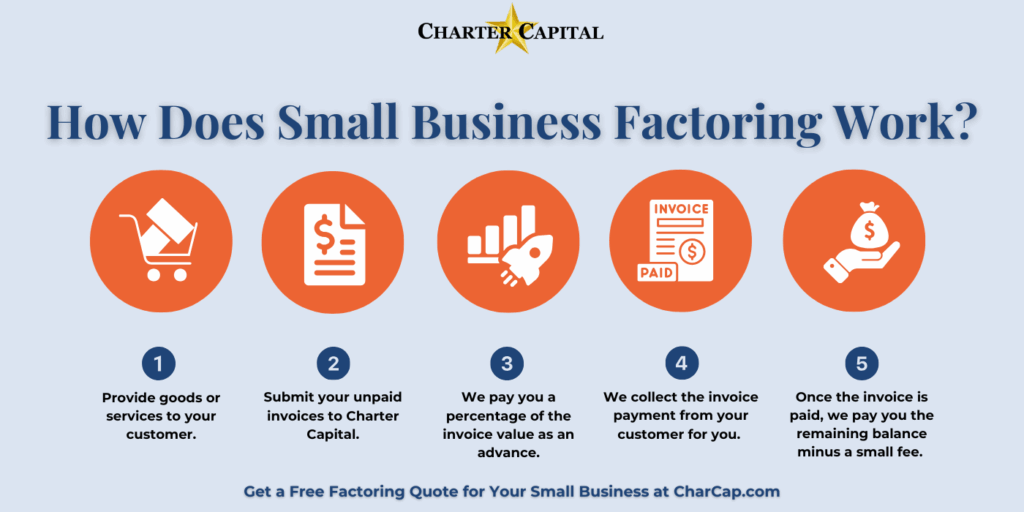
A typical advance from Charter Capital is around 90 percent of the invoice value, although some advances reach up to 98 percent. We leverage a digital invoice processing system that helps keep your funding on track effortlessly. Choose between standard processing, which has your cash in your bank account within 24-48 hours, and expedited processing, which provides you with funds on the day you submit your invoice. Either way, when you leverage small business factoring, invoice funding happens fast with Charter Capital. Here’s what to expect:
- Serve Your Customer: Take care of your customer like you always do.
- Submit Your Invoice: When you’re ready to invoice, send a second copy to us via your online portal.
- Receive Your Advance: Receive up to 98 percent of the invoice’s value right away.
- Focus on Your Business: We’ll take care of the collections process for you, so you can put your energy toward growing your business.
- Receive the Residual: Your factoring fee is collected when your customer pays the invoice. You receive the residual after that.
We Support Stability and Growth for Small Businesses of All Types
Charter Capital works with most small and startup businesses across a wide variety of industries. Our factoring agreements are flexible and can be tailored to meet the needs of your business, with no long-term contracts required and no minimum monthly volume requirements.

- Manufacturing: Keep production lines moving. With our tailored manufacturing factoring program, you can purchase materials, maintain inventory, or expand operations.
- Oil and Gas Services: Whether you’re in drilling, completions, well servicing, equipment rental, transportation, or anything in between, specialized oil and gas services factoring can align your payments with your work.
- Professional Services: Tailored factoring for professional services firms, such as consulting, IT, and marketing companies, makes it easier to cover payroll and take on new clients.
- Security: When you pay your guards weekly or bi-weekly, and clients get a month or more to pay, security firm factoring keeps payroll on track and can help you meet your growth goals.
- Staffing: Whether you put people to work in healthcare, manufacturing, skilled trades, technology, or another industry, our flexible staffing factoring program makes it easier to scale on demand and make payroll with ease.
- Trucking and Freight Services: Low margins, high maintenance costs, regulatory fees, and lengthy payment terms with shippers and brokers make managing cash flow difficult. Our dedicated freight factoring program keeps your wheels turning and can even provide you with a fuel card for discounts at stations nationwide. (Fuel cards not available in California.) Or, if you’re a freight broker who needs to expedite payments to carriers and grow, our freight broker factoring program can help.
Typical Factoring Fees and Rates for Small Businesses Are Between One and Three Percent
The volume of factored invoices, how long it takes your customers to pay, the dollar value of invoices factored monthly, the payment histories of your customers, and other details can influence your factoring fees and rates. However, we strive to keep factoring costs affordable. Most of our clients have factoring rates between one and three percent. You can also choose between a tiered or flat rate structure depending on what makes the most sense for your small business.
| Factoring Rate | Who Typically Qualifies |
|---|---|
| 1.0% – 2.0% | Small businesses with high invoice volume and customers with strong credit may negotiate these rates. |
| 2.1% – 3.5% | Most small businesses fall here. |
| 3.6% – 4.5% | Newer small businesses and startups with lower invoice volume may see these rates. |
| 4.6% – 5.0% | These rates are often only seen by small businesses leveraging non-recourse factoring. |
What Working with a Leading Small Business Factoring Company is Really Like
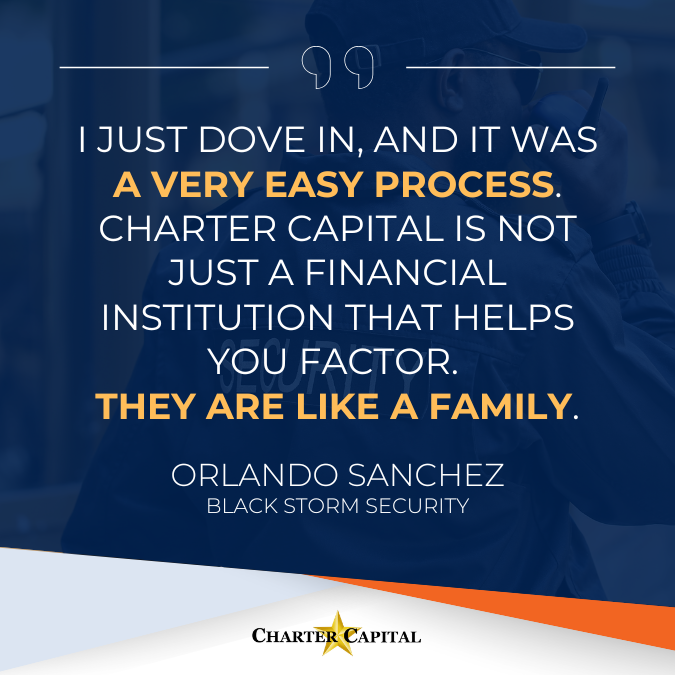
Orlando needed to keep up with tight payroll windows, but his clients expected industry-standard net-30 payment terms.
With small business factoring services from Charter Capital, he kept payroll on track and expanded from a single office bringing in $5,000 per month to 44 locations generating $280,000 per month in only seven years.
Small Business Factoring Companies Offer a Wealth of Benefits

- Avoid Debt: Factoring isn’t a loan, and the balance is cleared when your customer pays, so there’s no debt or interest to pay back.
- Improve Your Credit: If slow customer payments are making it difficult to keep up with your payables, factoring can make it easier to pay on time and maintain strong credit.
- Scale on Demand: Accept large orders or contracts without hesitation, knowing you can fund the upfront costs of labor and materials.
- Expand: Move into new markets, add locations, and more.
- Keep Up with Hiring and Payroll: Grow your team and retain talent with funds for recruitment and payroll.
- Purchase Supplies and Equipment: You can use your small business factoring funds in whatever way makes the most sense for your business.
- Manage Seasonal Swings: Whether ramping up or coping with a seasonal lull, factoring can keep you covered through the highs and lows.
- Strengthen Customer Relationships: Give your customers the breathing room they need on invoice payments and use extended payment terms to close more contracts.
- Take Control of Your Finances: Bring predictability to your cash flow, so it’s easy to forecast accurately, budget accordingly, and grow.
Charter Capital Stands Out as a Leader in Factoring Companies for Small Businesses
As America’s leading small business funding company for more than 25 years, Charter Capital provides unmatched value and unparalleled service.
- Same-Day Funding Submit your invoice early and receive funds in your account the same day.
- No Long-Term Contract Factor for one month or for life. You’re free to come and go as you wish.
- Flexible Terms Your final factoring agreement will be structured around your business needs.
- Free Collections While most factors will collect for you, we do so at no charge to your business.
- No Credit Score Minimum We can approve startups and small businesses that banks have denied.
- Instant Approval Get your quote and term sheet the day you apply.
- No Start-Up Fees We’ll waive your application fees and start-up costs. Pay nothing to get started.
- Personalized Service Work with a dedicated account manager who understands your business.
- Competitive Rates Get top-notch service and rates that average between one and three percent.
- Free Customer Credit Checks Make smarter decisions about extending credit with free reports.
Why People Choose Charter Capital Factoring for Small Business Funding
Partner with the Leading Factoring Company for Small Business
Comparing financing or invoice factoring quotes, looking for general information, or ready to move forward? Our team of funding specialists is standing by and happy to help. As America’s leading small business factoring company for over 25 years, we welcome the opportunity to help your business level up.
FAQs About Small Business Factoring
How does small business factoring work?
There are many ways to maintain a positive cash flow when growing your business and dealing with accounts receivable issues. One popular way to increase cash flow is invoice factoring. Invoice factoring is the practice of selling your accounts receivable (invoices) at a discount to another company. You get the money from the company that you sold your accounts receivable to, and they become responsible for collecting the outstanding invoice amount.
The reason many businesses get cash from unpaid invoices is to ensure the continuous flow of cash to the business. Essentially, businesses that use invoice factoring focus on having most of the money now rather than all of it later. It can take time to collect on an invoice, so when a company finances its accounts receivable, it gets its money faster and without the hassle of the collection process.
It’s especially important for small businesses to have working capital available through small business factoring. You can use the money to purchase new equipment, pay your bills, or cover payroll. The alternative is to chase down the customer for payment, deferring all other activities while the money is being collected.
With small business factoring, you can meet your business expenses without worrying about when your clients will pay. It’s the business loan alternative that provides businesses with predictable cash flow and positions them for growth.
How is factoring different from other forms of invoice funding for small businesses?
Invoice factoring is often confused with business invoice financing, also known as accounts receivable financing, but they’re different things. Invoice factoring involves the sale of your receivables, so there’s nothing to pay back. Invoice financing for small business is, as the name implies, financing. You are taking on a loan, so debt and interest accrue. Another key distinction is who collects. With factoring, your factor collects for you. With invoice-based financing, you manage collections.
With that being said, if you’re looking for invoice financing without a long-term contract, you’re probably a good candidate for factoring with Charter Capital even though it’s a different invoice funding solution.
How fast can a small business get funded through invoice factoring?
Small businesses can typically receive funding within 24 to 48 hours of submitting their first invoice to Charter Capital, with same-day invoice funding available once an account is set up.
Does my small business need strong credit to qualify for invoice factoring?
No. Charter Capital evaluates the creditworthiness of your customers rather than your own business credit, so small businesses with limited credit history or a short time in operation can still qualify. Even startups that are actively invoicing B2B clients can get approved.
How much funding can a small business access through invoice factoring?
The funding available through invoice factoring scales with your invoice volume, since Charter Capital advances a percentage of each invoice you choose to factor. Advances are typically around 90 percent of the invoice value, though can go up to 98 percent. Our typical client generates somewhere between $20,000 and $1,500,000 per month in sales, meaning it’s possible to receive factoring advances that total over $1 million per month.
What documents does a small business need to start invoice factoring?
When getting started with factoring, small business documentation is minimal. It typically requires basic business information and the invoices you want to factor; unlike a bank loan, small businesses don’t need to submit a business plan, tax returns, or audited financial statements.
Will my small business customers know I’m using a factoring company?
Your customers will receive a notice of assignment (NOA) that instructs them to remit payment to Charter Capital. For most, this comes across as nothing more than an everyday remittance update. If they need to speak with someone to make their payment, our white-glove collections team will handle the transaction with the same professional courtesy and care your internal team would.
What types of small businesses benefit most from invoice factoring?
Looking at the types of businesses using invoice factoring in the US, this funding option is particularly beneficial for industries with long billing cycles and frequent cash flow challenges. Sectors like transportation, staffing, security, janitorial, and maintenance often face delays of 30, 60, or even 90 days before clients pay their invoices. By selling these outstanding invoices to a factoring company at a discount, small businesses gain immediate access to working capital, enabling them to cover essential expenses without taking on debt. For instance, trucking companies are struggling with delayed payments. In these cases, freight bill factoring provides a reliable cash flow solution by converting unpaid invoices into immediate working capital.
Freight brokers can also benefit from tailored solutions like freight broker factoring, which helps ensure timely carrier payments and smooth cash flow between shipments.
These industries typically encounter high costs and regular operational demands, making cash flow consistency essential. Factoring provides stability for these businesses, with options like recourse and non-recourse factoring to meet specific needs. For instance, non-recourse factoring transfers the risk of unpaid invoices to the factoring company, which can be especially advantageous for businesses concerned about payment reliability.
Moreover, small businesses with limited credit history or only a short time in business can access factoring, as it relies on the customer’s creditworthiness rather than the business’s own financial standing. This allows newer businesses to manage cash flow and invest in their growth, even in the face of delayed payments from clients.
What makes invoice factoring an ideal small business loan alternative?
Bank financing has been difficult for small business owners since the beginning. This is especially true today because many small businesses are just unable to qualify for traditional business loans. The requirements of getting financing from a traditional lender are a major barrier. The company must typically have substantial assets, years of profitability, and audited financial reports.
Many business owners don’t consider alternative financing options. They are unaware that there are alternatives to traditional bank loans and SBA loans. After being rejected, they often give up hope of ever getting financing. The truth is, these alternatives might be better for your company than traditional financing. When you weigh the advantages and disadvantages, invoice factoring for small businesses in the USA often comes out ahead on speed and accessibility.
The biggest challenge for nearly all companies is their accounts receivable—the 30- to 60-day wait until the invoice is paid. During this waiting period, the accounts payable become due, and employees and suppliers need to be paid. This leads many businesses into a “cash flow crunch.” While this is fine for large, well-capitalized companies with adequate banking reserves, it is a significant challenge that many business owners face every day.
How do small business factor rates and discount rates work?
A factor rate is the percentage charged by a factoring company to advance funds against unpaid invoices. It typically ranges from one to five percent per invoice, depending on risk factors and the terms of the factoring agreement. At Charter Capital, most of our clients have rates between one and three percent.
Some factoring companies offer tiered pricing, where higher invoice volumes result in lower rates. The discount rate refers to the total cost deducted from the invoice before the final payment is released.
How do recourse vs. non-recourse factoring costs differ for small businesses?
When comparing recourse vs non-recourse factoring, the difference between these options significantly affects pricing for small businesses. Recourse factoring offers lower rates but requires businesses to repurchase invoices when the customer doesn’t pay. Non-recourse factoring shifts the risk to the factoring company, leading to higher fees due to increased liability.
What’s important when choosing the best factoring structure for a small business?
Since many factoring companies structure fees differently, reviewing contract terms is essential. The best factoring choice depends on cash flow needs and risk tolerance. Understanding these costs ensures businesses make informed decisions while maintaining steady cash flow.
How does factoring compare to sources of working capital for a small business?
When comparing sources of working capital for small business, invoice factoring stands out because it converts unpaid B2B invoices into immediate cash without adding debt. Other invoice factoring alternatives, such as business lines of credit or invoice financing, may have stricter credit requirements or create a repayment obligation.
For companies seeking cash flow financing for small businesses, factoring can also provide greater flexibility because funding scales with invoice volume. Charter Capital offers fast invoice funding for small business needs, with same-day funding available once your account is established and no long-term contract or minimum monthly volume requirement.
