Manufacturing Factoring Services
When your manufacturing business ships or delivers an order, the cash from that sale stays tied up in an unpaid invoice, often for 30, 60, or even 90 days, while your own costs for materials, payroll, and production keep coming due. Manufacturing factoring turns those outstanding invoices into working capital right away, without taking on new debt. Charter Capital works with manufacturers across food and beverage, medical, chemical, plastics, textile, and machine shop sectors, offering free credit reports on customers, bilingual support, transparent fee structures, and no sign-up fees, so funding grows with your production volume.
Accounts Receivable Factoring Provides Immediate Cash Flow for Manufacturing Companies
Charter Capital knows that cost-effective manufacturing can’t be sustained without a steady stream of working capital. Our goal is to use our invoice factoring services to provide an efficient form of financing for manufacturers, giving them easy access to the constant cash flow they need in order to be successful.
The Invoice Factoring Process for Manufacturers Is Easy:
- The orders have been shipped or delivered. You send an invoice to your client, and Charter Capital will verify the invoice.
- You are wired the cash advance for the manufacturing invoice (typically ranging from 70 to 90 percent of the invoice, and up to 98 percent in some cases).
- Once your client pays, we will release reserves.
If you need capital to buy raw materials or cover labor before an order ships, that’s a different kind of financing than factoring provides.
A Manufacturing Factoring Example
Here’s an illustrative example of where factoring fits into the order cycle: a machine shop completes a $30,000 order and ships it to its customer on Net 60 terms. Instead of waiting 60 days to get paid, the shop submits the invoice to Charter Capital the same day it ships. Charter Capital verifies the invoice and advances 90 percent, or $27,000, within 24 hours. Sixty days later, the customer pays the invoice in full. Charter Capital then releases the remaining $3,000, minus a 2 percent factoring fee ($600), for a final payment of $2,400. In total, the shop receives $29,400 of the $30,000 invoice.
Types of Companies in the Manufacturing Industry That Can Use Factoring
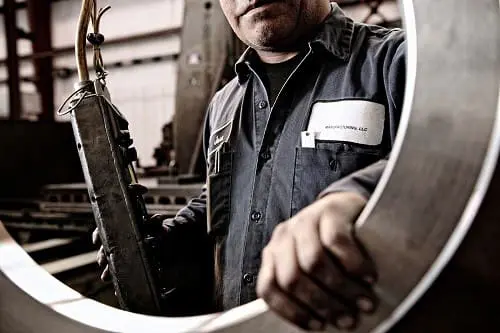
We provide manufacturing factoring services for companies in many fields, including but not limited to:
- Food and Beverage
- Vitamins
- Medical
- Consumer Goods
- Chemicals
- Plastics
- Textile
- Machine Shop
The Benefits of Manufacturing Invoice Factoring
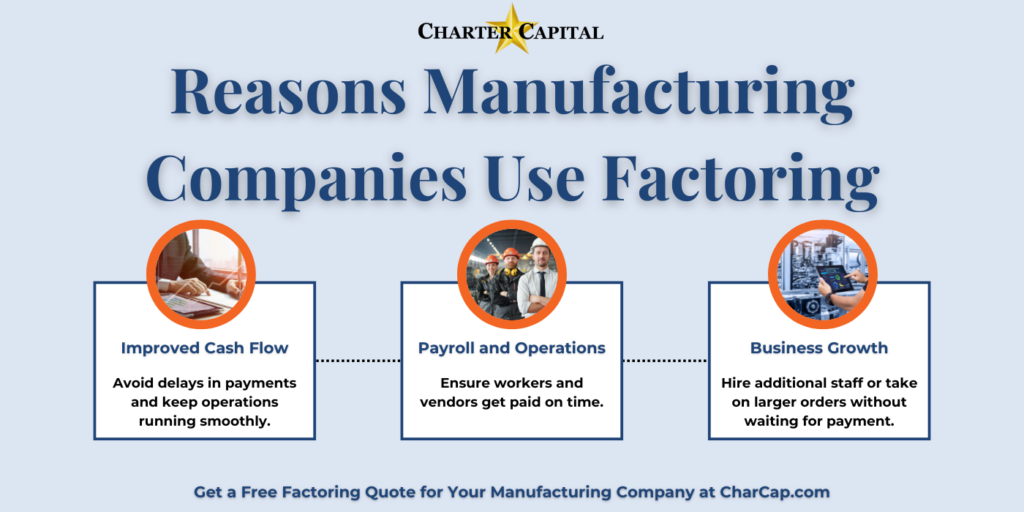
- With manufacturer factoring, you can worry less about recurring expenses like payroll, R&D, outside services, and other ongoing cash flow concerns that arise during slow economic periods.
- Getting cash up-front for your outstanding invoices allows your business to grow and invest in new equipment and inventory in order to stay competitive.
- The Invoice Factoring Process is Quick and Simple.
- Unlike traditional lines of credit or business loans for manufacturers, invoice factoring has an easy application and approval process and is even available to businesses that have a poor credit score.
Why Do Manufacturing Companies Benefit by Factoring Accounts Receivable with Us?
The use of our back-office support for collections and mailing of your invoices sometimes offsets the factoring fees or decreases internal overhead-related costs. For manufacturers, account receivable factoring works best when your factor understands production cycles and customer payment terms, not just the paperwork.
We are seasoned professionals with decades of industry experience.
Personalized Service – you have one dedicated person and their assistant who handles your account. You don’t have to start over with a new person each time you call.
Solve Your Cash Flow Issues with Tailored Factoring for Manufacturers
With more than 25 years of experience providing accounts receivable factoring, Charter Capital helps businesses just like yours grow stronger and scale every day. Our tailored manufacturing factoring services for manufacturing companies make it easy to get funding when you need it, with same-day payments available, and don’t require long-term commitments. To learn more or take the next step, request a no-obligation factoring estimate.
FAQs About Manufacturing Factoring
Does invoice factoring affect my relationship with my manufacturing customers?
No. Charter Capital verifies invoices with your customers as part of standard due diligence, but the process is professional and discreet. Many manufacturers use factoring for years without disruption to customer relationships, since payment terms and delivery commitments stay unchanged from the customer’s perspective.
Is there a minimum invoice volume required for manufacturing factoring?
Charter Capital works with manufacturers across a range of invoice volumes, from smaller machine shops to larger production operations, and funding generally scales with your accounts receivable.
Can manufacturers use factoring proceeds for raw material purchases?
Yes. Once funds are advanced against an invoice, manufacturers can direct that working capital toward raw materials, payroll, equipment, or any other operational need. Charter Capital does not restrict how factoring proceeds are used once they reach your account.
How does invoice factoring handle partial shipments or progress billing?
Charter Capital reviews each invoice individually, so partial shipments and progress billing common in manufacturing can be factored as separate invoices once verified. This lets manufacturers access cash tied to completed production stages rather than waiting for a full order to ship.
What happens if a manufacturing customer disputes an invoice after funding?
Disputed invoices are handled directly between the manufacturer and their customer, with Charter Capital’s back office support available to help with documentation questions. Reserves tied to a disputed invoice are typically held until the dispute is resolved and payment is confirmed.
