
SBA loans are among the most sought-after small business financing options. However, navigating the system, understanding your options, and getting approved for an SBA loan can be difficult. In this guide, we’ll walk you through how SBA loans work, the types of SBA loans available, and SBA loan alternatives to explore if you’re denied an SBA loan or decide they’re not the right fit for your business financing needs.
What Are SBA Loans and How Do They Work?
The U.S. Small Business Administration (SBA) offers several loan programs designed to help small businesses access funding for working capital, equipment purchases, expansion, commercial real estate, and other operational needs.
Instead of providing funds directly to businesses, the SBA supports these loans by reducing lender risk, and businesses apply through approved lenders that evaluate eligibility, creditworthiness, and repayment ability.

How the SBA Loan Process Works
The exact process for an SBA loan varies depending on the loan type and lender. However, most SBA loans follow a similar approval process.
- Choose an Approved SBA Lender: You begin by selecting a bank, credit union, or other lender authorized to offer SBA-backed financing.
- Begin the SBA Loan Application Process: You submit your application along with basic business information, financial statements, tax documents, and any additional materials requested by the lender.
- Go Through the Underwriting Process: The lender reviews your credit score, business finances, operating history, and overall ability to repay the loan.
- Receive SBA Review and Approval: If your application meets the lender’s requirements, the lender works with the U.S. Small Business Administration to finalize the SBA-backed guarantee when required.
- Review and Sign Your Loan Agreement: Once approved, you review the loan terms, repayment schedule, interest rate, and any additional funding conditions before closing.
- Receive Your Funds: After the agreement is finalized, your lender disburses funds that can be used for approved business purposes.
- Begin Repayment: You begin making scheduled payments directly to your lender based on the repayment terms outlined in your agreement.
Standard Requirements for SBA Loan Approval
While the exact requirements for an SBA loan are determined by the loan type and lender, a few criteria are universal.
- Meet Size Standards: Your business must qualify as a small business under SBA guidelines. These are industry-specific and are set by revenue and/or number of employees. For instance, a local freight trucking business may qualify if its gross income is under $34 million annually. However, manufacturers are measured by the number of employees, with some limits as low as 500, depending on the product being manufactured.
- Operate for Profit: Nonprofits are excluded from SBA loan funding. Further, your business must be registered and operate legally.
- Sound Business Purpose: Your business must serve a sound purpose, and the funds must be used to support that purpose.
- Do Business in the U.S.: Your business must be located and operate in the United States or one of its territories.
- Be Creditworthy: Although requirements vary, the SBA will require proof that you have the ability to pay back the loan.
- Exhausted Financing: SBA loan options are specifically designed for businesses that can’t qualify for funding without its guarantee of repayment to the lender and for situations in which the terms would be unreasonable.
SBA Loan Programs and SBA Loan Types
As a borrower, you may not need to know all the different SBA loan programs or loan types offered, as lenders offering SBA loans will typically assess your needs and try to match you to the ideal program. However, having a basic familiarity with the options ahead of time can help you assess the fit before you apply and avoid any unnecessary hard credit pulls.
| SBA Loan Program | SBA Loan Types | Maximum Amount | Primary Purpose |
|---|---|---|---|
| SBA 7(a) Loan Program | Standard 7(a), 7(a) Small, SBA Express, Export Express, Export Working Capital, International Trade | Up to $5 million (varies by type) | General business financing, working capital, inventory, expansion, refinancing |
| 504 Loan Program | Standard 504 Loan | Typically up to $5.5 million + | Commercial real estate, facility expansion, major equipment purchases |
| Microloan Program | Standard SBA Microloan | Up to $50,000 | Startup funding, small equipment purchases, working capital |
| Disaster Loan Program | Physical Disaster Loans, Economic Injury Disaster Loans | Varies by Program | Recovery after physical damage or economic hardship caused by declared disasters |
Standard SBA 7(a) Loans
Perhaps one of the most confusing aspects of SBA loans is that 7(a), sometimes written as 7a, can be used in reference to the SBA 7(a) Loan Program, which includes a variety of different loans, or it can refer to one of two loan types that carry the same name: the Standard 7(a) and the 7(a) Small.
The 7(a) Loan Program is the SBA’s flagship program, and the Standard 7(a) Loan is arguably the most popular offering within the program because it can serve a variety of different purposes and has a high funding ceiling, which enables businesses to address everything from working capital needs to inventory and business acquisitions.
Funding Amount for Standard SBA 7(a) Loans
The Standard SBA 7(a) Loan can provide sums of $350,001 to $5 million.
With some of the larger loans, typically those used for real estate, borrowers get up to 25 years before the loan reaches maturity. However, five to ten years is more common. When the loan is used to secure equipment, repayment timelines cannot exceed the life of the equipment.
Interest Rates for Standard SBA 7(a) Loans
You’ll negotiate your interest rate with your lender. However, the SBA sets limits on how much interest a lender may charge.
| Standard SBA 7(a) Loan Amount | Maximum Interest Rate |
|---|---|
| $350,001 to $5 million | Base Rate + 3.0% |
Application and Credit Score Requirements for Standard SBA 7(a) Loans
The minimum credit score for a Standard 7(a) Loan starts at around 640, with individual lenders setting their own requirements. However, many start at closer to 680 or 690. You’ll also need to have been in business for at least two years and have an annual revenue of $100,000 or more.
Approval and Payout Timeline for Standard SBA 7(a) Loans
The SBA’s turnaround time for a Standard 7(a) Loan is five to ten business days. However, this is just one portion of the approval process. It usually takes 60 to 90 days from the time a business applies until the funds hit your bank account.
Limitations on Use of Proceeds for Standard SBA 7(a) Loans
The SBA sets limits on how the proceeds from financing can be used. However, the Standard SBA 7(a) Loan is quite flexible, and covers everything from real estate to working capital needs, refinancing business debt, purchasing equipment, and procuring supplies. Proceeds cannot be used for things like personal use/reimbursing owners for personal investments, speculative investing, paying off delinquent taxes, or lending.
SBA 7(a) Small Loans
The equally versatile, but less sizable, cousin of the Standard 7(a) is the SBA 7(a) Small Loan.
Funding Amount for SBA 7(a) Small Loans
SBA 7(a) Small Loans have a cap of $350,000, with no official minimum financing amount set. Repayment timelines are on par with 7(a) Standard Loans.
Interest Rates for SBA 7(a) Small Loans
Interest rates are negotiated with your lender, though the SBA sets caps for 7(a) Small Loans.
| SBA 7(a) Small Loan Amount | Maximum Interest Rate |
|---|---|
| $50,000 or less | Base Rate + 6.5% |
| $50,001 to $250,000 | Base Rate + 6.0% |
| $250,001 to $350,000 | Base Rate + 4.5% |
Application and Credit Score Requirements for SBA 7(a) Small Loans
The SBA references the FICO SBSS Score (Small Business Scoring Service) for 7(a) Small Loans. It’s a blended number from 0 to 300, with 300 referencing the lowest risk. To qualify for an SBA 7(a) Small Loan, the minimum SBSS Score is 165. However, personal scores tend to be on par with the Standard 7(a), with most lenders looking for a 650 to 680 or higher.
If your small business loan is $50,000 or less, the SBA does not require collateral. Further, loans of any size cannot be declined solely on the basis of inadequate collateral. However, lenders must follow their written collateral policies and procedures for non-SBA guaranteed commercial loans outside of this.
Approval and Payout Timeline for SBA 7(a) Small Loans
Per the SBA, turnaround time on a 7(a) Small Loan is two to ten days. However, like the Standard 7(a), this is only the SBA’s portion. Most businesses won’t see funds for 60 to 90 days after their application.
Limitations on Use of Proceeds for SBA 7(a) Small Loans
Spending limitations on proceeds align with the 7(a) Standard guidelines, with hard limits set on things like personal use, illegal activities, and delinquent taxes. Funds can be used on most legitimate business expenses.
SBA Express Loans
Like the Standard SBA 7(a) and SBA 7(a) Small, SBA Express Loans fall under the broader SBA 7(a) Loan Program. However, as the name implies, SBA Express Loans are designed to move faster by giving lenders greater authority to approve financing without waiting for the same level of SBA review required for other 7(a) loan types. They are also distinct in that they can be provided as term loans or as lines of credit.
This faster approval process makes SBA Express Loans appealing when access to funding is more time-sensitive. In some cases, businesses facing temporary cash flow disruptions while waiting on longer-term financing may also encounter an SBA bridge loan, which operates under the SBA Express framework for certain disaster-related funding situations.
Funding Amount for SBA Express Loans
SBA Express Loans offer financing up to $500,000. SBA Express Loans and Lines of Credit can have up to a ten-year maturity period.
Interest Rates for SBA Express Loans
Interest rates for SBA Express Loans are negotiated directly with your lender, though the SBA places limits on what lenders can charge.
| SBA 7(a) Express Loan Amount | Maximum Interest Rate |
|---|---|
| $50,000 or less | Base Rate + 6.5% |
| $50,001 to $250,000 | Base Rate + 6.0% |
| $250,001 to $350,000 | Base Rate + 4.5% |
| $350,001 to $500,000 | Base Rate + 3.0% |
Application and Credit Score Requirements for SBA Express Loans
Most lenders expect you to have at least two years in business and more than $100,000 in annual revenue. You’ll also likely need a personal credit score of at least 650 to qualify for an SBA Express Loan.
Note that SBA Express Loans cannot be declined solely because you lack sufficient collateral. Outside of this, many lenders use their existing collateral policy for these loans.
Approval and Payout Timeline for SBA Express Loans
Lenders who provide SBA Express Loans are authorized to process, close, and service loans without SBA review. Because of this, each lender sets its own timeframe. You can generally expect the full process, from application to funding, to take between 30 and 60 days.
Limitations on Use of Proceeds for SBA Express Loans
As with the other 7(a) loan options, use of funds from an SBA Express Loan have few limitations. As long as you’re using the financing to cover legitimate business expenses, you’re usually in the clear.
SBA Export Express Loans
SBA Export Express Loans are designed specifically for businesses that export goods or services internationally. Like the standard SBA Express Loan, this financing option prioritizes faster approvals by allowing lenders to make more decisions without waiting on direct SBA review.
The key distinction is that SBA Export Express Loans are intended to help businesses enter or expand within international markets. Funds can be used to support export development activities, fulfill export orders, or strengthen operations tied directly to international sales.
Funding Amount for SBA Export Express Loans
SBA Export Express Loans provide financing up to $500,000. Like standard SBA Express Loans, they can be structured as either term loans or revolving lines of credit. However, revolving lines of credit may not exceed seven years.
Interest Rates for SBA Export Express Loans
Interest rates are negotiated directly with your lender, though the SBA sets maximum interest rates based on the size of the loan.
| SBA 7(a) Export Express Loan Amount | Maximum Interest Rate |
|---|---|
| $50,000 or less | Base Rate + 6.5% |
| $50,001 to $250,000 | Base Rate + 6.0% |
| $250,001 to $350,000 | Base Rate + 4.5% |
| $350,001 to $500,000 | Base Rate + 3.0% |
Application and Credit Score Requirements for SBA Export Express Loans
Qualification requirements are similar to those for standard SBA Express Loans, though lenders will also expect to see evidence that your business is actively engaged in exporting or preparing to expand into international markets. Most lenders look for at least two years in business, annual revenue of $100,000 or more, and a personal credit score of 650 or higher.
Collateral policies for the Export Express Loan align with the SBA Express Loan policies, meaning insufficient collateral cannot be the sole reason for a denial. However, lenders typically follow their standard policies outside of this.
Approval and Payout Timeline for SBA Export Express Loans
Like SBA Express Loans, lenders offering SBA Export Express Loans have delegated authority to approve financing without direct SBA review. Because of this, funding timelines are generally faster than traditional SBA loan options, with most businesses receiving funds within 30 to 60 days after applying.
Limitations on Use of Proceeds for SBA Export Express Loans
Funds from an SBA Export Express Loan must be used to support export-related business activities. This can include financing export orders, participating in foreign trade shows, purchasing inventory for export sales, or supporting expansion into international markets. Funds cannot be used for personal expenses or non-business purposes.
SBA Export Working Capital Loans
While SBA Export Express Loans are designed to help businesses enter or expand into international markets, SBA Export Working Capital Loans are specifically intended to help businesses finance export transactions. This loan type focuses less on general export growth and more on ensuring businesses have the working capital needed to fulfill international orders and manage the cash flow challenges that often come with global trade.
Because of this narrower purpose, SBA Export Working Capital Loans are often used when businesses need immediate access to capital for production costs, inventory purchases, supplier payments, or other expenses tied directly to export sales.
Funding Amount for SBA Export Working Capital Loans
SBA Export Working Capital Loans can provide financing up to $5 million. Unlike SBA Express products, these loans are generally structured as short-term working capital solutions tied directly to specific export transactions rather than long-term financing arrangements. Revolving lines of credit have terms of 36 months or less.
Interest Rates for SBA Export Working Capital Loans
Interest rates for SBA Export Working Capital Loans are negotiated directly with your lender, though the SBA sets limits on what participating lenders may charge. Maximum rates generally follow the same SBA guidelines used for other 7(a) loan products.
| SBA 7(a) Export Working Capital Loan Amount | Maximum Interest Rate |
|---|---|
| $50,000 or less | Base Rate + 6.5% |
| $50,001 to $250,000 | Base Rate + 6.0% |
| $250,001 to $350,000 | Base Rate + 4.5% |
| $350,001 to $5 million | Base Rate + 3.0% |
Application and Credit Score Requirements for SBA Export Working Capital Loans
To qualify, you’ll need to demonstrate that the financing is directly connected to export-related business activity. Lenders generally review personal credit history, business financials, repayment ability, and your export sales pipeline. While specific credit score requirements vary, many lenders look for scores of at least 650 along with an established operating history.
It’s also worth noting that collateral is usually required. However, the inventory produced and foreign accounts receivable generated by the export sales financed typically provide adequate coverage.
Approval and Payout Timeline for SBA Export Working Capital Loans
Unlike SBA Express products, SBA Export Working Capital Loans still involve SBA review as part of the approval process. While timelines vary depending on the lender and complexity of the transaction, businesses should generally expect the full approval and funding process to take between 30 and 90 days.
Limitations on Use of Proceeds for SBA Export Working Capital Loans
Funds from an SBA Export Working Capital Loan must be used specifically to support export transactions. Common uses include purchasing inventory, covering production costs, financing foreign receivables, paying suppliers, or supporting other short-term expenses directly tied to fulfilling international sales. Funds cannot be redirected toward unrelated business operations or personal use.
SBA International Trade Loans
While several SBA loan options support businesses engaged in exporting, SBA International Trade Loans are specifically designed for businesses planning long-term international expansion or businesses facing competitive pressure from foreign imports. Unlike SBA Export Working Capital Loans, which focus on financing individual export transactions, International Trade Loans support larger strategic investments tied to global growth.
Because of this broader purpose, businesses often use SBA International Trade Loans when expanding facilities, purchasing equipment, refinancing debt related to international growth, or making other long-term investments that improve their ability to compete internationally.
Funding Amount for SBA International Trade Loans
SBA International Trade Loans can provide financing up to $5 million. Repayment terms generally follow the structure of other SBA 7(a) loan products, with longer maturity periods available when financing real estate or major equipment purchases.
Interest Rates for SBA International Trade Loans
Interest rates for SBA International Trade Loans are negotiated directly with your lender, though the SBA sets limits on how much participating lenders can charge. Maximum rates generally follow the same guidelines used for other SBA 7(a) loan products.
| SBA 7(a) International Trade Loan Amount | Maximum Interest Rate |
|---|---|
| $50,000 or less | Base Rate + 6.5% |
| $50,001 to $250,000 | Base Rate + 6.0% |
| $250,001 to $350,000 | Base Rate + 4.5% |
| $350,001 to $5 million | Base Rate + 3.0% |
Application and Credit Score Requirements for SBA International Trade Loans
Because SBA International Trade Loans are often used for larger expansion projects, lenders typically take a close look at financial history, repayment ability, and long-term business stability. Most lenders expect at least two years in business, annual revenue above $100,000, and a personal credit score of 650 or higher. You’ll also need to demonstrate how the financing supports international trade activity or helps your business remain competitive against foreign imports.
Approval and Payout Timeline for SBA International Trade Loans
SBA International Trade Loans generally follow a timeline similar to Standard SBA 7(a) Loans, since they require lender underwriting and SBA review before approval. While turnaround times vary, businesses should generally expect the full approval and funding process to take between 60 and 90 days.
Limitations on Use of Proceeds for SBA International Trade Loans
Funds from an SBA International Trade Loan must be used to support international business growth or improve competitiveness in foreign markets. This can include purchasing equipment, expanding facilities, refinancing debt tied to international expansion, or funding other long-term investments related to trade. Funds cannot be used for personal expenses or unrelated business activity.
SBA 504 Loans
Unlike the various loan types offered under the SBA 7(a) Loan Program, SBA 504 Loans are designed specifically to help businesses finance major fixed assets. Rather than providing flexible funding for general business expenses, the 504 program focuses on long-term investments that help businesses grow, such as purchasing commercial real estate, constructing facilities, or acquiring expensive equipment. Because of this, the 504 is sometimes called an SBA business acquisition loan.
SBA 504 Loans are also structured differently than other SBA financing options. Instead of working exclusively with a lender, financing is typically split between a traditional lender, a Certified Development Company (CDC), and the borrower, who is generally required to contribute a down payment toward the project.
Funding Amount for SBA 504 Loans
SBA 504 Loans typically provide up to $5.5 million through the CDC-backed portion of the financing arrangement, though total project funding can exceed this amount when combined with the lender’s portion of the loan. Repayment periods generally extend up to 10, 20, or 25 years, depending on how funds are being used.
Interest Rates for SBA 504 Loans
Unlike SBA 7(a) Loans, where lenders negotiate rates within SBA limits, SBA 504 Loans typically offer fixed interest rates on the CDC portion of the financing. The lender portion of the financing is negotiated separately and may carry different terms depending on the institution providing the loan.
Because rates are influenced by treasury yields and monthly debenture sales, exact rates fluctuate over time rather than following a fixed SBA rate cap structure.
Application and Credit Score Requirements for SBA 504 Loans
Because SBA 504 Loans are generally used for larger capital investments, lenders often apply stricter qualification standards than other SBA financing options. Most lenders expect strong business financials, a personal credit score of at least 680, and sufficient cash reserves to cover the required equity contribution, which often starts at 10 percent of the total project cost.
You’ll also need to demonstrate that the project supports an eligible business purpose and that the financed asset will primarily be used by your business.
Approval and Payout Timeline for SBA 504 Loans
Because SBA 504 Loans involve both a lender and a Certified Development Company, the approval process is often more complex than other SBA loan options. Multiple parties must review the application, underwriting documents, and project details before financing can move forward.
As a result, businesses commonly wait between 60 and 90 days from application to funding, though larger or more complex projects may take longer.
Limitations on Use of Proceeds for SBA 504 Loans
SBA 504 Loans cannot be used for general working capital needs or day-to-day operating expenses. Instead, funds are reserved for major fixed-asset investments that support long-term business growth.
This typically includes purchasing owner-occupied commercial real estate, constructing new facilities, renovating existing properties, or acquiring large equipment with a long useful life. Funds generally cannot be used for inventory purchases, payroll expenses, debt consolidation, or other short-term operational needs.
SBA Microloans
While many SBA loan programs are designed to support established businesses seeking larger amounts of capital, the SBA Microloan Program is intended to help startups and smaller businesses access modest amounts of financing when traditional lending options may be out of reach.
Unlike other SBA loan programs, the SBA does not work directly with banks to issue Microloans. Instead, funds are distributed through nonprofit intermediary lenders, which often provide additional business training and technical assistance alongside the financing itself.
Funding Amount for SBA Microloans
SBA Microloans provide financing of up to $50,000, though the average microloan tends to be significantly smaller. Repayment terms can extend up to seven years, depending on the lender and how the funds are being used.
Interest Rates for SBA Microloans
Unlike SBA 7(a) Loans, which follow standardized SBA rate caps, Microloan interest rates are set by the nonprofit intermediary lender issuing the financing. Because of this, rates vary widely, though most fall somewhere between eight and 13 percent.
Application and Credit Score Requirements for SBA Microloans
Qualification requirements for SBA Microloans are often more flexible than those for larger SBA loan programs, making them more accessible to newer businesses with limited operating history. However, each intermediary lender sets its own standards.
While some lenders work with lower credit scores, you should still expect lenders to review your credit history, business plan, projected revenue, and ability to repay the loan.
Approval and Payout Timeline for SBA Microloans
Because SBA Microloans are issued through nonprofit lending partners rather than traditional banks, approval timelines vary considerably depending on the lender. In many cases, businesses receive funding within 30 to 60 days, though some applications move faster.
Limitations on Use of Proceeds for SBA Microloans
SBA Microloans can be used for many common business expenses, including working capital, inventory purchases, supplies, furniture, fixtures, and equipment purchases.
However, unlike many other SBA loan programs, Microloan funds cannot be used to purchase real estate or refinance existing debt.
SBA Physical Disaster Loans
Unlike other SBA loan programs, which are designed to help businesses grow or access working capital, SBA Physical Disaster Loans exist specifically to help businesses recover after federally declared disasters. These loans provide funding when physical property has been damaged or destroyed by events such as hurricanes, floods, wildfires, tornadoes, or other qualifying emergencies.
Because the purpose of these loans is recovery rather than expansion, SBA Physical Disaster Loans focus on helping businesses repair or replace damaged property so operations can resume as quickly as possible.
Funding Amount for SBA Physical Disaster Loans
SBA Physical Disaster Loans can provide up to $2 million in financing, though the exact amount depends on the extent of uninsured or underinsured damage sustained during the disaster. Repayment terms can extend up to 30 years, depending on the borrower’s financial condition and ability to repay.
Interest Rates for SBA Physical Disaster Loans
Unlike most other SBA loan programs, interest rates for SBA Physical Disaster Loans are set directly by the SBA rather than negotiated with a lender. Rates vary depending on whether the business has access to other forms of credit, but they are generally kept below standard commercial borrowing rates.
Application and Credit Score Requirements for SBA Physical Disaster Loans
Qualification for an SBA Physical Disaster Loan depends heavily on demonstrating physical damage tied directly to a declared disaster area. While the SBA still reviews credit history and repayment ability, underwriting standards are generally more flexible than traditional business loan programs because the financing exists specifically to support recovery efforts.
Applicants will also need to provide documentation related to property damage, insurance claims, and estimated repair or replacement costs.
Approval and Payout Timeline for SBA Physical Disaster Loans
Because these loans are often issued during widespread disaster events, processing times can vary significantly depending on application volume. In many cases, initial approvals move faster than traditional SBA lending, though final funding timelines depend on damage assessments, documentation review, and insurance coordination.
Limitations on Use of Proceeds for SBA Physical Disaster Loans
Funds from an SBA Physical Disaster Loan must be used to repair or replace physical property damaged during the disaster. This can include repairing buildings, replacing equipment, restoring inventory, or replacing other business assets necessary for normal operations.
Funds cannot be used for expansion projects, unrelated operating expenses, or business investments outside of disaster recovery.
SBA Economic Injury Disaster Loans
While SBA Physical Disaster Loans help businesses repair or replace property damaged during a disaster, SBA Economic Injury Disaster Loans address a very different problem. These loans are designed to help businesses cover financial losses caused by a disaster when revenue is disrupted, even if the business itself did not suffer direct physical damage.
Rather than paying for repairs or replacing damaged property, SBA Economic Injury Disaster Loans provide working capital that helps businesses continue meeting financial obligations while recovering from economic hardship caused by a declared disaster.
Funding Amount for SBA Economic Injury Disaster Loans
SBA Economic Injury Disaster Loans can provide up to $2 million in financing, though the amount available depends on the extent of economic harm suffered and the business’s ability to repay. Repayment terms can extend up to 30 years, depending on financial circumstances and the structure of the loan.
Interest Rates for SBA Economic Injury Disaster Loans
As with other disaster-related SBA financing programs, interest rates are set directly by the SBA rather than negotiated with a lender. Rates vary depending on whether the business has access to other forms of credit, but they are generally structured to remain below standard commercial borrowing rates.
Application and Credit Score Requirements for SBA Economic Injury Disaster Loans
Approval for an SBA Economic Injury Disaster Loan depends largely on proving that a declared disaster directly caused financial harm to your business. While the SBA still reviews credit history and repayment ability, underwriting standards are often more flexible than traditional business loan programs because the purpose of the financing is business recovery rather than expansion.
Applicants may need to provide tax records, financial statements, revenue documentation, and records showing the economic impact caused by the disaster.
Approval and Payout Timeline for SBA Economic Injury Disaster Loans
Processing timelines vary depending on the scale of the disaster event and the number of applications being processed by the SBA. Because the agency handles these loans directly, funding may move faster than traditional SBA lending in some situations, though documentation review and verification requirements can still create delays.
Limitations on Use of Proceeds for SBA Economic Injury Disaster Loans
Funds from an SBA Economic Injury Disaster Loan are intended to help businesses continue covering ordinary operating expenses during the recovery period. This can include payroll, rent, utilities, accounts payable, and other financial obligations that cannot be met because of disaster-related revenue loss.
Unlike Physical Disaster Loans, funds cannot be used to repair property damage or replace destroyed physical assets unless specifically allowed under separate disaster recovery programs.
Discontinued SBA Loan Programs
Over the years, the SBA has introduced several loan programs designed to address temporary economic conditions, support underserved borrowers, or serve specific industries. However, not every SBA financing option remains available indefinitely, and some older programs that still appear online have since been discontinued.
- SBA Manufacturers’ Access to Revolving Credit (MARC) Loans: The SBA introduced this pilot program to help manufacturers access revolving lines of credit backed by the SBA 7(a) Loan Program, though the program is no longer active.
- SBA Community Advantage Loans: The SBA created this specialized 7(a) loan program to improve access to financing for underserved businesses, but the program officially expired in 2023 and is no longer accepting applications.
- SBA Paycheck Protection Program (PPP) Loans: The federal government introduced PPP Loans during the COVID-19 pandemic to help businesses cover payroll and operating expenses, but the program stopped accepting applications in 2021.
- COVID Economic Injury Disaster Loans (COVID EIDL): The SBA expanded the Economic Injury Disaster Loan program during the COVID-19 pandemic to help businesses cover working capital and operating expenses during periods of economic disruption, but the program stopped accepting new applications in 2022. Standard EIDLs, as covered above, are still available.
SBA Loan Application Checklist
While exact requirements vary depending on the lender and SBA loan program, most lenders will ask for similar documentation during the application process. Preparing these materials ahead of time can help reduce delays and make the underwriting process move more smoothly.
- A Completed SBA Loan Application: Most lenders require a formal loan application outlining how much financing you need, how the funds will be used, and basic information about your business.
- A Business Plan: If you are applying as a newer business or startup, lenders may require a business plan that explains your operations, growth strategy, market opportunity, and financial projections.
- Business and Personal Tax Returns: Most lenders request multiple years of tax returns to verify revenue history, profitability, and overall financial stability.
- Business Financial Statements: You should expect to provide documents such as profit and loss statements, balance sheets, cash flow statements, and other records that help demonstrate financial health.
- Personal and Business Credit Information: Lenders will review both business and personal credit history to assess repayment risk and determine whether you meet qualification requirements.
- Business Licenses and Formation Documents: Most lenders require documents proving your business is legally registered and authorized to operate within your state and industry.
- Collateral Documentation: Depending on the loan amount and loan type, lenders may require documentation related to business assets, equipment, inventory, or real estate being used to secure financing.
- Financial Projections or Revenue Forecasts: Some lenders request forward-looking financial projections that demonstrate your ability to repay the loan based on expected future revenue.
- Personal Financial Statements: Owners may need to provide personal financial statements detailing assets, liabilities, income sources, and overall net worth.
Common Challenges with SBA Loans and the SBA Loan Process
Despite the fact that there are many positives to SBA loans, there are also drawbacks that may influence whether an SBA loan is right for your business.
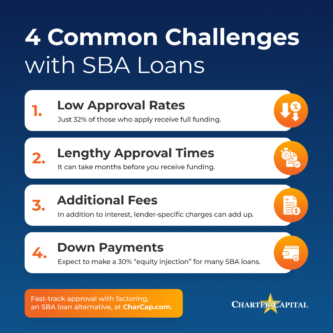
Low Approval Rates
SBA loans are designed to reduce lender risk to improve approvals, but borrowers must still meet strict approval criteria before financing is granted. Credit score requirements, minimum revenue thresholds, time in business requirements, collateral expectations, and repayment history all influence approval decisions.
Just 32 percent of small businesses that apply for SBA loans are fully approved, according to the latest Small Business Credit Survey. This leaves 29 percent receiving only partial approval, and 40 percent outright denied financing. This makes SBA loans the least accessible form of funding that the U.S. Federal Reserve Banks tracks for the survey.
Lengthy Approval Timelines
Between document collection, underwriting, lender review, and final approval, it can take weeks or even months before funds are disbursed. If your business is facing immediate cash flow challenges, these extended timelines can create serious operational difficulties.
Additional Fees
Beyond interest charges, SBA loans often come with additional costs that increase the total cost of borrowing. Depending on the loan type, borrowers may encounter SBA guarantee fees, packaging fees, closing costs, servicing fees, and other lender-specific charges during the application and funding process. While these fees vary depending on the lender and loan structure, they can significantly increase upfront borrowing costs.
It’s also worth noting that some include prepayment penalties, which means that, if you pay off your loan early, you’ll be assessed an additional fee for doing so.
Down Payments
Many SBA loans require down payments. In the language for 7(a) and 504 loans, it’s typically referred to as an “equity injection,” and is associated with the purchase of an asset, such as real estate or heavy machinery. The amount varies but is usually between ten and 30 percent of the asset’s cost. Your required upfront investment will likely be higher if your business hasn’t been in operation for long, if you’re purchasing a property for special use, or if your business looks riskier on paper for other reasons.
SBA Loan Alternatives
Even if you find the best SBA loan lenders, you may still walk away without cash or without enough to meet your needs. It’s helpful to familiarize yourself with SBA loan alternatives and how they work ahead of time.
SBA Loan vs. Bank Loan
Both SBA loans and traditional bank loans provide businesses with access to capital that is repaid over time with interest. The primary difference is that SBA loans are partially backed by the U.S. Small Business Administration, which reduces lender risk and often allows for more favorable rates and repayment terms. Traditional bank loans are funded entirely by the lender without government backing, which can lead to stricter approval requirements but may also create a faster, more streamlined approval process.
SBA Loan vs. Conventional Loan
While SBA loans and conventional loans function similarly, the key distinction is that conventional loans are issued without government backing. Because lenders assume the full risk, conventional loans often come with stricter approval requirements, such as higher credit score expectations, stronger financials, and more collateral. However, businesses that qualify may benefit from a faster approval process since conventional loans do not require SBA involvement during underwriting.
SBA Loan vs. Business Line of Credit
Some SBA loan programs can function as lines of credit. However, most SBA financing options involve a more structured application process, stricter qualification requirements, and longer approval timelines. A business line of credit is often easier to access and gives you ongoing flexibility to borrow only what you need when expenses arise, rather than applying for a new loan each time additional working capital is required.
SBA Loan vs. Equipment Financing
While SBA loans can often be used to purchase equipment, equipment financing is designed specifically for that purpose. The primary difference is that equipment financing uses the equipment itself as collateral, which can make approval easier and reduce the need for additional security. SBA loans generally offer more flexibility in how funds are used, while equipment financing is better suited for businesses that need to purchase specific machinery, vehicles, or other high-cost operational equipment.
SBA Loan vs. Merchant Cash Advance (MCA)
Both SBA loans and merchant cash advances provide businesses with access to working capital, but the similarities largely end there. SBA loans typically offer lower borrowing costs, longer repayment periods, and more consumer protections, while merchant cash advances prioritize speed and accessibility. However, businesses considering an MCA should proceed carefully, as many MCA providers charge extremely high effective rates and use aggressive repayment structures that can create a cycle of debt quickly if cash flow becomes strained.
SBA Loan vs. Invoice Factoring
While SBA loans provide businesses with access to borrowed capital repaid over time with interest, small business factoring, also known as accounts receivable factoring, converts open business-to-business (B2B) invoices into immediate working capital by selling accounts receivable. Because approval is based primarily on your customers’ creditworthiness rather than your own financial profile, invoice factoring is often more accessible to businesses that need fast cash flow solutions but may not meet the strict qualification requirements or the lengthy approval timelines associated with SBA financing.
Invoice Factoring as an SBA Loan Alternative
| Invoice Factoring | SBA Loans | |
|---|---|---|
| How it Works | Selling unpaid invoices to a third party | Borrowing funds from a third party |
| Funding Speed | Fast; payments can arrive on the same day invoices are submitted and approval may occur on the day you apply | Slow; most SBA loans take 30 to 90 days or more from the time you apply until funds reach your bank account |
| Approval Focus | The creditworthiness of your customers | Your creditworthiness, time in business, and collateral |
| Approval Odds | High | Low |
| Debt/Liability | Does not add debt to your balance sheet | Adds debt that must be repaid with fixed, periodic interest |
| Cost | Factoring rates are typically 1% to 5% of an invoice’s value; Charter Capital clients are usually at 3% or less | Interest rates typically range from 5.6% to 14.75%, depending on the loan type |
| Scalability | Automatically scales with your business | Additional sums or higher limits require a new application |
| Best For | B2B businesses with open invoices that require immediate working capital or short-term cash | Small businesses that require short or long-term financing and can meet rigid criteria |
Partner with Charter Capital for Your Invoice Factoring Services
SBA loans work best for businesses that have the time to go through the application process and that meet their stringent requirements. But for those who can’t wait 90 days, don’t want a lengthy or difficult application process, or don’t meet the requirements, we can help. Serving small businesses across the nation for more than 25 years, Charter Capital makes factoring simple with approval and terms delivered on the day you apply, plus same-day funding and competitive rates. We also won’t tie you into a long-term contract, and we’ll take care of your collections free. To learn more or get started, request a no-obligation rate quote.
FAQs on SBA Loans and SBA Loan Alternatives
What’s an SBA loan?
SBA Loan Definition: An SBA loan is a business financing solution partially guaranteed by the U.S. Small Business Administration and issued by participating lenders such as banks and credit unions. Because the government guarantee reduces risk for lenders, SBA loans often offer competitive interest rates, longer repayment terms, and higher borrowing amounts than many traditional business financing options.
How does an SBA loan work?
Instead of lending directly, the U.S. Small Business Administration guarantees a portion of the loan to reduce lender risk. You apply through an approved lender, which reviews your credit, finances, and eligibility before issuing funds for approved business purposes.
What is an SBA 7a loan?
An SBA 7(a) loan is the SBA’s primary lending program and offers flexible financing for working capital, inventory, equipment purchases, expansion, debt refinancing, and business acquisitions. Depending on the loan type, borrowers may access up to $5 million in funding.
What is an SBA 504 loan?
An SBA 504 loan helps businesses finance major fixed assets such as commercial real estate, facility construction, and heavy equipment. Unlike SBA 7(a) loans, funds cannot be used for general working capital, payroll, or most day-to-day operating expenses.
What’s the difference between an SBA 504 Loan vs. 7(a)?
SBA 7(a) loans offer flexible financing that can be used for working capital, inventory, equipment, and expansion. SBA 504 loans are more restrictive and are designed specifically for major fixed-asset purchases such as commercial real estate and large equipment.
How long does it take to get an SBA loan?
Most SBA loans take between 30 and 90 days from application to funding. The exact timeline depends on the loan type, lender requirements, underwriting complexity, and whether additional SBA review is required before approval is finalized.
How long does an SBA loan take after approval?
After approval, SBA loan funds are usually disbursed within a few business days to a couple of weeks. However, the exact timeline depends on closing requirements, final documentation, lender processing speed, and whether any additional conditions must be satisfied.
What’s a typical SBA loan approval time?
The approval process for an SBA loan usually takes several weeks, though some programs move faster. SBA Express Loans may receive lender approval quickly, while traditional SBA loans often take 30 to 90 days before funds are available.
What happens if you default on an SBA loan?
If you default on an SBA loan, the lender may pursue collections, seize collateral, and report the default to credit agencies. Because many SBA loans require a personal guarantee, business owners may also be held personally responsible for repayment.
What are the pros and cons of SBA loans?
SBA loans often offer lower interest rates, longer repayment terms, and higher borrowing limits than many alternatives. However, they can be difficult to qualify for, require extensive documentation, involve lengthy approval timelines, and may include additional fees or down payment requirements.
How much can I borrow with an SBA loan?
Borrowing limits depend on the loan program. SBA Microloans offer up to $50,000, while many SBA 7(a) and export loan programs provide up to $5 million. SBA 504 loans can exceed $5.5 million, depending on total project costs.
What credit score do I need for an SBA loan?
Credit score requirements vary by lender and loan type, but most SBA lenders look for personal credit scores of at least 650 to 690. Some programs may allow lower scores, though stronger credit generally improves approval odds and loan terms.
What documents do I need for an SBA loan?
Most lenders require an SBA loan application, business and personal tax returns, financial statements, credit information, business formation documents, financial projections, and details explaining how the funds will be used before approving financing.
What’s the difference between an SBA loan vs. business loan?
An SBA loan is one type of business loan backed partially by the U.S. Small Business Administration. Business loans is a broader term that includes SBA loans, conventional loans, lines of credit, equipment financing, merchant cash advances, and other financing options.
What is factoring, and how does it work as an SBA loan alternative?
Invoice factoring gives businesses immediate cash by selling unpaid invoices to a factoring company instead of borrowing money through a lender. Because approval depends largely on customer creditworthiness, factoring receivables can be a faster alternative for businesses that need working capital quickly.
DISCLAIMER: This article is not intended to provide tax, legal, financial, or accounting advice. This material has been prepared for informational purposes only, and is not intended to provide, and should not be relied on for, tax, legal, financial, or accounting advice. You should consult your own tax, legal, financial, and accounting advisors before engaging in any transaction.

- Charter Capital Welcomes Danika Louis as its New COO - October 20, 2026
- SBA Loan and Factoring Subordinations: A Detailed Guide - September 28, 2026
- Cost Savings Remain Top Business Outsourcing Benefit - September 23, 2026
