
Trying to squeeze more out of your days or just feeling overwhelmed by the sheer number of tasks on your plate? While some might say the strain is unavoidable, the reality is that time management strategies for business owners can help alleviate these burdens.

Benefits of Implementing Time Management Strategies
The right time management strategies can give you literal hours back each day, allowing you to focus on what matters most and gain greater peace of mind.
Improve Business Productivity
While the total hours worked by business owners is widely debated, with some sources clocking it at 50 to 60 and others suggesting owners of early-stage companies and startups routinely grind for 90 hours per week, we do know that putting in extra time doesn’t always yield better results. In fact, once you reach 55 hours, productivity drops so much that adding more time is essentially pointless, Stanford research shows. Implementing effective time management strategies for business owners, therefore, is one of the few levers left at your disposal if you’re already at your max.
Each tactic you integrate has potential value. For instance, investing as little as ten minutes in planning your day each morning can yield two hours of productivity gains, Zippia reports. The key, therefore, isn’t to integrate every possible strategy all at once. It’s to find strategies that fit how you actually work, and that you can stick with, so you gain incremental boosts that compound over time.
Lower Stress
In all, 42 percent of small business owners report experiencing symptoms of burnout in the past month, while 24 percent say they’re actively experiencing burnout, according to Lifehack Method. Social isolation, constant uncertainty, and overworking are contributing factors, the U.S. Chamber of Commerce reports. Improved time management can help alleviate the strain.
But it’s also worth noting that chronic time pressure is a problem in its own right. Research shows it’s a significant predictor of symptoms of depression, anxiety, and stress, per Liverpool John Moores University. Reducing time pressure won’t magically solve serious mental health conditions, but it can play a role in mitigation or reducing symptoms, particularly if it’s part of a comprehensive treatment plan overseen by a mental health professional.
Create Work-Life Balance for Business Owners
Many entrepreneurs report being on-call 24/7, logging in after-hours, or feeling stretched too thin for social activities and obligations outside of work. This lack of work-life balance often leads to burnout. Improving your time management skills can boost efficiency and allow for greater balance, research from the University of Alabama shows.
10 Proven Time Management Strategies for Business Owners
Every person operates differently. The time management strategies that work best for someone else may not work for you and vice versa. This is no doubt why people try an average of 13 different time management techniques, per Zippia research. As you evaluate the time management strategies for business owners in the list below, consider how each would fit into your natural workflows and behaviors, or how it can be adapted to suit you. Keep what works and drop the rest.
1. Get Organized
The first step is to ensure you’re organized, so you can focus on what actually matters and reduce time wasted searching for things.
- Goals: Make sure you have clear, actionable, and measurable business goals. These will be vital as you determine where to focus your efforts later.
- Workspace: Cluttered workspaces waste an average of 45 minutes per day, Zippia reports. That amounts to 4.3 hours per week. Because virtually all activities to improve time management depend on your workspace, make organizing it a top priority.
- Schedule: As touched on, spending a few minutes per day organizing your day can give you two hours back. Even if you’re not ready for a full overhaul, allow some time every morning to review what needs to be done and determine when you want to do it.
2. Know Your Worth
Assign yourself an hourly wage. This can be what you actually earn in a reasonable workweek, assuming you’re paying yourself a fair wage or based on the skills you use at work. For instance, the average management consultant at McKinsey earns just shy of $70 per hour, per Indeed. However, rates for a managing director or partner typically start at over $150 per hour, with some earning double that and exceeding seven figures annually. You may not be able to compensate yourself at this level now, but it can help you put your workload into perspective.
That doesn’t mean you should live by the “time is money” mantra. It can lead to negative outcomes, such as time pressure, stress, and impatience, and ultimately undermine psychological and physical health, researchers at Concordia University say. Instead, you’ll defer to this figure when determining what is worth your time.
3. Develop Delegation Strategies
Knowing your worth can make delegation decisions easier. For instance, if you’re resolving a customer concern on a major account, that could be worth your time if it preserves the relationship. However, if you’re personally chasing invoices and someone else can do it effectively for $20 or $25 an hour, it doesn’t make sense to have it on your plate.
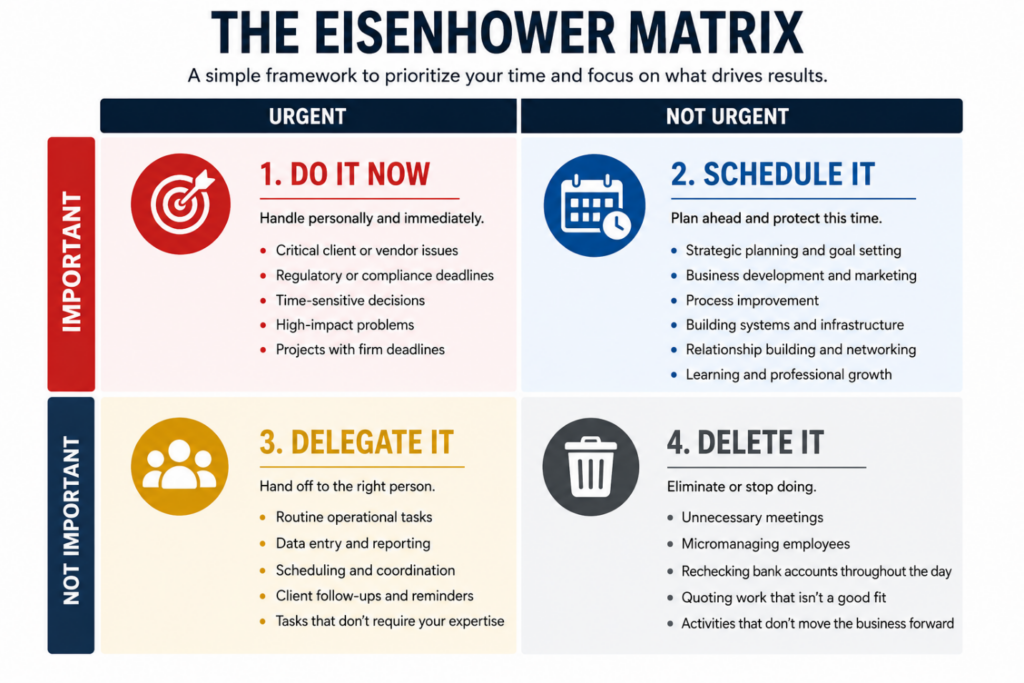
The Eisenhower Decision Matrix is another strategy you can use. With this approach, you’ll create a 2×2 grid. At the top of the columns, add the titles “Urgent” and “Not Urgent.” For the row headers, use “Important” and “Not Important.”
You’ll then label your sections “Do,” “Schedule,” “Delegate,” and “Delete.”
- Do: If tasks are important and urgent, they will go in the “Do” section. This includes high-priority tasks with imminent deadlines that require your immediate attention, such as critical client or vendor issues, high-impact problems, projects with deadlines, regulatory or compliance deadlines, or time-sensitive decisions. The idea is to focus your efforts here first.
- Schedule: If tasks are important but not urgent, they’ll go in the “Schedule” quadrant. This includes tasks that contribute significantly to long-term well-being, growth, and goals, but do not have an immediate deadline. This might include strategic planning, business development, process improvements, relationship-building, and professional development. You’ll add these items to your schedule so that they get addressed as time allows, but before they become emergencies.
- Delegate: If tasks are not important but are urgent, they’ll go in the “Delegate” section. These tasks demand immediate attention but don’t require your involvement. They can include things like routine operational tasks, scheduling and coordination, administrative tasks, and data entry and reporting. You’ll hand them off to employees, contractors, virtual assistants, or automated workflows.
- Delete: Tasks that are not important and not urgent go in the “Delete” quadrant. These tasks don’t support your goals and offer little to no value. They can include things like unnecessary meetings, micromanaging employees, rechecking bank account balances throughout the day, and quoting work that isn’t a good fit for your business. While it’s still good practice to respond politely to customers who aren’t a good fit, and you may need to replace some meetings with emails or virtual collaboration tool, the goal is to eliminate these tasks entirely or stop engaging with them.
4. Harness the Power of “No”
Your reputation and relationships are everything in the business world, which can make it difficult to say “no,” even when something isn’t a good fit or shouldn’t be on your plate. A structured process can help you move past the awkwardness and preserve goodwill.
- Show Gratitude: Thank the person for coming to you.
- Give a Polite Boundary: If you’re unable to assist because something isn’t within the scope of your work, you’re maxed, or the terms don’t work, you can politely say so.
- Offer an Alternative: Whenever possible, leave the person with alternate next steps. That might mean referring them to another business that can serve their needs better, asking them to circle back through a different channel or at a later date, or proposing alternate terms.
If you decline the same requests repeatedly, consider building email templates to automate the response or adding details to your website that cover the situation.
5. Cut Unnecessary Meetings
Leaders spend an average of 72 percent of their workweek in meetings, per Zippia. If you don’t actually need to have everyone together in real time, consider shifting to email or a digital collaboration tool.
6. Block Out Time on Your Schedule
Multitasking and interruptions can erode your time. Add blocks to your schedule for periods you need to work without interruptions and to ensure you stay on track.
- Time Boxing: The most common method is time boxing, where you set aside blocks for different tasks to ensure you stay focused and have ample time to complete the work.
- Pomodoro Method: The Pomodoro method is similar, but you work in 25-minute blocks. Each block is followed by a five-minute break. This may be more helpful for those who struggle with focus or fatigue.
- Energy Matching: Reserve your most productive hours for your most challenging work. For some people, that might mean digging into deep-thinking activities first thing in the morning. For others, it might mean waiting a few hours after the start of the day or doing it after lunch. Similarly, it’s generally best to make decisions earlier in the day, as decision fatigue can creep in as the day winds down.
- Eat Your Frog First: If you have one task you’ve been dreading, or that’s especially difficult, consider “eating your frog first” by tackling it before moving on to easier items. This can increase the likelihood that it will get done rather than deferred.
- Include Downtime: Be sure to schedule some downtime each day and leave space for emergencies.
- Block Personal Time: If you have the tendency to check in after-hours or work late, block out your personal time as a mental reminder that you need to pause and create work/life balance.
7. Maximize the Use of Digital Productivity Tools and Automation in Business
Automation saves the typical person 3.6 hours per week, according to Salesforce. That amounts to 23 working days freed up annually. Use it and other digital productivity tools to help you maintain focus, streamline your work, and eliminate repetitive tasks.
- Protect Your Focus: The average person is interrupted 11 times per hour, per Zippia. Use digital tools to minimize distractions and silence notifications while you’re working. If you’re using time blocks, consider automating this to align with your scheduled blocks.
- Automate Repetitive Tasks: Look for recurring tasks that follow the same process every time, such as appointment reminders, invoice generation, recurring payments, email follow-ups, or report generation. Even small automations can save hours over time.
- Centralize Your Work: Switching between multiple apps wastes time and increases the likelihood of missing important information. Whenever possible, use tools that integrate with one another so your calendar, email, accounting software, customer relationship management (CRM) platform, and project management platform stay synchronized.
- Use AI Strategically: The use cases for AI in business are endless. It can help draft emails, summarize meetings, organize notes, generate reports, or brainstorm ideas. Use it to reduce administrative work, but always review the output before relying on it for important business decisions.
8. Create Systems and Build Efficient Workflows, But Don’t Over-Monitor
As your business grows, create systems that reduce repetitive work and improve consistency. Update them when your business changes or you identify meaningful opportunities for improvement, but don’t fall into the trap of constantly tweaking processes or monitoring every result. Once a workflow is working well, let it do its job.
9. Consider the 80/20 Rule for Task Prioritization
The 80/20 Rule, also known as the Pareto Principle, suggests that roughly 80 percent of results come from 20 percent of efforts. While the exact ratio won’t always hold true, the concept is a useful reminder to focus on the work that delivers the greatest return rather than treating every task as equally important.
- Identify Your High-Value Activities: Determine which clients, products, services, or activities generate the greatest revenue, growth, or customer satisfaction, and make them a priority.
- Reduce Low-Value Work: Look for tasks that consume a disproportionate amount of time without contributing meaningfully to your business. Delegate, automate, or eliminate them whenever possible.
- Reassess Regularly: Your highest-value activities will change as your business grows. Periodically review where your time is going to ensure it still aligns with your goals.
10. Forecast Your Finances
Use financial forecasting to get a clearer picture of upcoming cash flow, so you don’t have to repeatedly check your bank balance or lose time scrambling when a shortfall catches you off guard. Most accounting software can automate financial forecasting to save you even more time. If a gap does arise, invoice factoring can provide a fast solution because approval and funding are quick. You can also set up a factoring relationship before you need it, so access to cash is ready when time is limited.
Improve Your Time Management with Charter Capital
When you partner with Charter Capital for your invoice factoring needs, we take care of the collections for you, freeing you from chasing invoices and giving you back hours each week. Factoring also makes cash flow management simpler, plus with our straightforward process, same-day approval, and same-day payments, you can focus more on the strategic work that drives your business forward. To learn more or get started, request a no-obligation rate quote.
FAQs About Time Management for Business Owners
How long does it typically take to see results from improved time management?
Many business owners notice small improvements within days of applying a new time management strategy, such as spending a few minutes planning each morning. Larger shifts, like consistently delegating tasks or automating recurring work, tend to compound over several weeks as new habits replace old patterns and free up more consistent blocks of time.
What time management challenges are most unique to small business owners compared to employees?
Unlike employees with defined roles, business owners often juggle sales, operations, finances, and customer service simultaneously, with no clear boundary between work and personal time. This constant context switching, combined with being the final decision-maker on nearly everything, makes prioritization and delegation more difficult than in a traditional employee role.
How can business owners measure whether their time management strategies are actually working?
Track how much time specific tasks take before and after implementing a new strategy, and note whether high-priority work is getting done on schedule. A drop in missed deadlines, fewer after-hours work sessions, and more consistent daily planning are practical signs that a time management approach is producing real results.
How does invoice factoring help business owners spend less time on collections?
Invoice factoring shifts the work of following up on unpaid invoices to the factoring company, so business owners no longer need to track down late payments themselves. This frees up hours each week that would otherwise go toward collections calls and payment reminders, time that can be redirected toward core business activities.
What types of tools can help business owners track tasks and priorities?
Calendar and scheduling apps, project management platforms, and time-tracking software can all help business owners see where their time is going and what still needs attention. The right combination depends on workflow, but tools that centralize tasks, deadlines, and priorities in one place tend to reduce the time lost switching between systems.

- How Personal Finances Impact Business Funding - October 12, 2026
- 6 Tips for Managing a 20 Percent or Greater Inventory and Labor Cost Increase - September 14, 2026
- How Do I Submit My First Invoice with Charter Capital? - September 9, 2026
