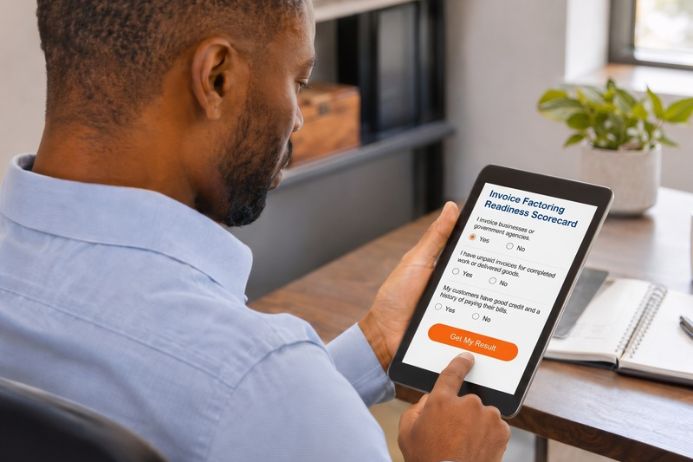
Want to know if you’re likely to qualify for factoring and, if so, how good of a fit it will be? Our Invoice Factoring Readiness Scorecard can provide you with some clarity.
Invoice Factoring Readiness Scorecard
Select Yes or No for each statement, then select Get My Result.
0 of 14 answered
Essential Requirements
Additional Readiness
This scorecard provides an initial assessment based on your answers. Requirements vary by factoring company. Final approval depends on the factoring company’s review.
Powered by Charter Capital.
What the Self-Assessment for Factoring Can and Can’t Tell You
The self-assessment for factoring includes a mix of common approval requirements and questions that can help identify how smooth your transition will be if you move forward. It can’t guarantee that you’ll be approved or denied, but it can give you a clearer indication of where you stand and what to improve if you don’t score as well as you’d hoped.
Regardless of your score, our team is happy to walk you through the process, perform a more thorough assessment, and answer any questions you may have. We don’t store or save a copy of your score, so please take a screenshot of your results or print your screen if you’d like to reference it later.
Essential Requirements for Invoice Factoring Eligibility
The first block of questions on the invoice factoring self-assessment addresses core requirements for factoring. If you answered “no” to any of them, you’ll likely need to improve your score before you can qualify for factoring. Details for each question are outlined below.
My business is legally established and has a dedicated business bank account.
You’ll need a legally established business and a dedicated business bank account. The factoring company is purchasing your business’s invoices, so it pays your business through an account in its name, keeping company and personal funds separate.
My business generates at least $20,000 in monthly revenue.
Every factoring company sets its own minimum revenue threshold. While many factors set this at $50,000 or $100,000 per month, Charter Capital provides small business factoring services for those generating as little as $20,000 monthly. We also support businesses generating over $1,000,000 monthly, which allows our clients to grow with us.
I invoice businesses or government agencies.
Only your open invoices with clients who are businesses or government agencies are eligible for factoring. Although you can serve a consumer market as well, those invoices can’t be factored.
I have unpaid invoices for completed work or delivered goods.
Invoices for prepayment don’t qualify for factoring. However, with Charter Capital, you can submit your invoices the moment work or goods are delivered and receive your factoring advance on the same day.
My customers have good credit and a history of paying their bills.
Your personal credit history has little to no impact on your factoring eligibility. Instead, factors review the payment history of your clients, as they’re the ones paying the invoices.
If you’re unsure if your clients are in good standing, you can pull a report from a credit bureau and review their score, such as a PAYDEX Score from Dun & Bradstreet. Or, if you become a Charter Capital client, we’ll perform our own evaluation and share our findings with you at no additional charge.
My invoices are current, accurate, and undisputed, with clear payment terms and supporting records.
Past-due invoices or those older than 90 days generally don’t qualify for factoring. Factors also need accurate details, clear payment terms, and supporting records to verify what your customers owe and when payment is due. Correct any errors and resolve billing disputes before submitting invoices for funding, as these can impact your advances.
No other entity has a claim to my receivables, such as a lender or the IRS.
When you factor an invoice, you transfer the rights to it to the factoring company. If another entity already has a claim to your accounts receivable, they’re generally ineligible for factoring. This is a common but unfortunate situation for businesses that take out high-cost merchant cash advances (MCAs) or have liens from the Internal Revenue Service (IRS).
If another entity already has a claim on your receivables and you still want to factor, check your contract or speak with the other party to find out if subordination is an option. This means the other party agrees to give the factoring company priority on your receivables. Some will allow it if it makes it easier for you to cover your obligations.
My business taxes are current or covered by an approved payment arrangement.
Unpaid business taxes can lead to liens on your receivables, which can affect your factoring eligibility. If you owe back taxes, you may still qualify with an approved payment arrangement. Contact the appropriate tax agency to discuss a plan, and stay current on both scheduled payments and new tax obligations.
I can provide business and invoice records.
When you apply for factoring with Charter Capital, we’ll need:
- Your Articles of Incorporation or d/b/a/ filing
- A copy of the principal’s driver license
- Your A/R and A/P reports
- A master customer list
- Sample invoices
- Example contracts (if applicable)
Other factoring companies may require additional documentation, such as bank statements and tax records.
Additional Readiness Traits from the Business Funding Scorecard
Meeting a few additional criteria helps ensure the fit will be strong and can make your factoring experience smoother. We explore these points in greater depth below.
I have been invoicing clients and receiving payments for at least three months.
Factoring advances aren’t traditional startup capital. You need to have an established invoicing history. It usually takes around three months for startups to build history, although some factors may require a longer history.
I issue invoices promptly, track due dates, and keep payment records current.
Following invoicing best practices helps ensure you get paid faster, which can reduce your overall cost of factoring. It also helps reduce the likelihood of disputes.
I am comfortable outsourcing collections on factored invoices.
Factoring companies collect invoice balances directly from your customers, much like an outsourced billing support company might do (not to be confused with a debt collector or collections agency). At Charter Capital, we have a professional team dedicated to customer service to handle payment processing as needed, and the service is provided at no additional charge.
Many of the businesses we collect balances from appreciate our services and professionalism so much that they become referral partners and begin sending their other vendors our way.
My business is profitable.
Invoice factoring provides working capital to help bridge cash flow gaps. By ensuring you get paid when work is completed or goods are delivered, instead of weeks or months later, factoring can make it easier to cover things like payroll or inventory needs. It works especially well if you’re growing, have a temporary strain, or are coping with seasonality. However, it doesn’t solve underlying profitability issues. Those need to be resolved independently of your funding solution.
My largest customer accounts for less than 20 percent of my business’s total revenue.
If the majority of your revenue comes from a small number of clients, a single delayed payment or instance of non-payment may be incredibly difficult to recover from. High customer concentration doesn’t always disqualify you from factoring, but it’s one of the risk signals factors may evaluate when determining eligibility and rates.
It’s worth noting that this refers to overall revenue, not necessarily the revenue generated through the invoices you’re factoring. For instance, at Charter Capital, some of our clients factor invoices for a single customer, although their overall customer base is larger.
Discuss Your Invoice Factoring Readiness Scorecard Results or Get a Quote
As America’s leading invoice factoring company for over 25 years, Charter Capital makes factoring simple. Whether you’re ready to apply, have questions about the approval process, or want to know what you can do to improve the likelihood of approval, our team is happy to help. Request a no-obligation rate quote to get started.
FAQs About the Invoice Factoring Readiness Tool and Small Business Funding
Who can use the quick funding check tool?
Anyone with an interest in invoice factoring can use the Charter Capital Invoice Factoring Readiness Scorecard. You don’t need to be ready to apply for factoring or be signed up with us to use it.
How is the Invoice Factoring Readiness Scorecard different from a formal factoring company evaluation?
An evaluation can give you a definitive answer. The self-assessment is an approximation. Every factoring company is different, and some have a little bit of flexibility surrounding the requirements. For this reason, you might find that you don’t meet all the core requirements on the Scorecard, but you can still qualify for factoring. Equally, you may score incredibly well and be declined by a factor because their requirements are more rigid, they don’t factor in your region, or they don’t serve your industry. Some factors only support the trucking industry, while others support staffing or manufacturing.
If I didn’t score well, is there any benefit to having a formal business funding assessment?
There may be a benefit to speaking with a specialist if you want a definitive answer about whether you qualify or to get tips on how to improve your position.
What invoice factoring metrics should I be aware of before I apply?
In order to better understand your terms sheet or agreement, you should be familiar with the following metrics:
– Advance Rate: This is the percentage of an invoice’s face value paid upfront. It’s usually between 70 and 90 percent of the invoice’s value, though we offer advances up to 98 percent at Charter Capital.
– Factoring Rate: This is the fee charged by the factoring provider, often quoted as a percentage of invoice value. It’s normally between one and five percent. At Charter Capital, most of our clients have rates between one and three percent.
– Residual: This is what you receive after your customer pays their invoice. It’s the full amount paid, minus your advance and any fees. Some factors refer to this as the reserve.

- Invoice Factoring Readiness Scorecard: Self-Assess Your Eligibility in 5 Minutes - November 23, 2026
- 10 Predatory Lending Red Flags for Businesses - October 26, 2026
- Charter Capital Welcomes Danika Louis as its New COO - October 20, 2026
