
If inventory and labor cost increases are making it difficult for you to predict expenses and run a profitable business, you’re not alone. Costs have been skyrocketing in recent years, and revenue hasn’t kept pace for many.

Overall, 77 percent of small businesses say they’ve experienced challenges with rising costs in the past 12 months, per the latest Small Business Credit Survey. Specifically, 73 percent cite the increased cost of goods, services, and/or wages, while 42 percent point to costs associated with tariffs as a financial challenge. Not surprisingly, just 16 percent of small business owners say they’re very comfortable with their cash flow situation, per the latest U.S. Chamber of Commerce Small Business Index.
Below, we’ll take a look at the inventory and labor cost increase, who’s feeling the crunch most, and what you can do about it.
The Ongoing Inventory and Labor Cost Increase is Squeezing Businesses Across the Nation
On average, businesses across all private-sector industries have seen a 3.3 percent increase in compensation costs over the past 12 months, per recent Bureau of Labor Statistics (BLS) data. This includes everything from wages to salaries and employer costs for employee benefits. It may not seem like much on its own, but it amounts to an average 22.5 percent hike across all private-sector industries over the past five years, BLS data show.
Labor Cost Increases by Industry
Naturally, the labor cost increases impact industries differently. However, even those with more modest recent gains have seen a dramatic climb over the past few years. For example, administrative and support services, which experienced a 2.6 percent hike over the past 12 months, still have a 22.1 percent gain in labor costs over the past five years. Meanwhile, professional, scientific, and technical services experienced a 20.9 percent hike in five years. Other notable five-year increases include manufacturing, at 21 percent, and transportation, at 25 percent.
| Industry | 12-Month Compensation Cost Increase | 5-Year Compensation Cost Increase |
| U.S. Private-Sector (All Industries) | 3.3% | 22.5% |
| Administrative and Support Services | 2.6% | 22.1% |
| Manufacturing | 3.3% | 21.0% |
| Professional, Scientific, and Technical Services | 3.0% | 20.9% |
| Transportation and Warehousing | 3.4% | 25.0% |
| Wholesale Trade | 3.3% | 21.0% |
Inventory Cost Increases by Industry
The inventory cost rise is equally pronounced, with the average 12-month increase at 3.8 percent and the five-year hike at 22.1 percent, per Federal Reserve Economic Data (FRED). Transportation and manufacturing are among those hit the hardest, coming in with five-year increases of 25.8 percent and 26.6 percent, respectively.
| Industry | 12-Month Intermediate Input Cost Increases | 5-Year Intermediate Input Cost Increases |
| U.S. Private-Sector (All Industries) | 3.8% | 22.1% |
| Administrative and Support Services | 3.6% | 19.4% |
| Manufacturing | 4.6% | 26.6% |
| Professional, Scientific, and Technical Services | 3.3% | 17.3% |
| Transportation and Warehousing | 3.4% | 25.8% |
| Wholesale Trade | 3.4% | 21.1% |
Small Businesses Feel the Crunch More
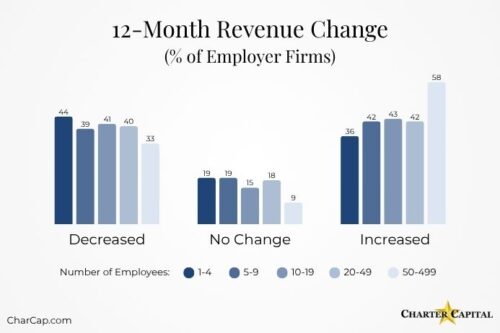
Smaller businesses appear to be having greater difficulty offsetting rising costs through revenue growth. For instance, businesses with ten to 49 employees were nearly evenly divided between revenue gains and declines, according to the Federal Reserve’s Firms in Focus by Employment Size report. Meanwhile, 58 percent of businesses with 50 to 499 employees reported increased revenue.
Profit trends show the effects extend beyond revenue. The share of owners reporting lower earnings exceeded the share reporting higher earnings by 16 percentage points, according to the latest NFIB Small Business Economic Trends data. Among those reporting lower profits, 16 percent attributed the decline to rising material costs, NFIB data show. Even when sales hold steady or increase, rising inventory and labor costs can leave less capital available to cover overhead, build cash reserves, and fund growth.
6 Proven Cost Management Strategies
While your revenue may not take you as far as it once did, there are still many business cost strategies that can stretch your dollars.
1. Improve Supply Chain Management
Start with the purchasing categories that account for most of your spending and request competing bids based on identical specifications, quantities, freight charges, and payment terms. Use those bids to renegotiate with current suppliers, consolidate purchases when volume discounts yield net savings, and qualify a backup source for critical inputs.
2. Enhance Operational Efficiency
Track paid labor hours against completed units, shipments, service calls, or jobs to identify overtime, idle time, duplicate work, slow approvals, and rework that increase labor costs. Then adjust staffing schedules to demand, standardize frequent tasks, cross-train employees, and automate repetitive administrative work. Measure the results using labor cost per completed unit or job, since total payroll may increase as sales grow.
3. Strengthen Production Cost Control
Set expected input quantities and costs for each product, job, or contract, then compare your estimates with actual usage and spending. Investigate variances caused by scrap, spoilage, defects, inaccurate specifications, or work outside the agreed scope. Require approval before additional materials or out-of-scope work are added, and correct recurring variances before they carry into future estimates.
4. Prioritize Higher-Margin Work
Rank products, services, jobs, and customer accounts by the gross profit they produce for each labor hour or unit of limited capacity they require. Include customer-specific costs such as expedited shipping, special packaging, returns, and extensive service demands. Use the results to decide which work to promote, stock, schedule first, or stop pursuing so your available inventory and labor generate the greatest return.
5. Adjust Prices and Contract Terms
Use current inventory and labor costs to establish a minimum acceptable margin for new quotes and contract renewals. Apply targeted price increases where margins have narrowed most, and set minimum invoice values that cover fixed processing and fulfillment costs. For longer agreements, use cost-escalation clauses, shorter quote-validity periods, and separate freight or tariff charges that may change. Follow the agreement’s notice and renewal provisions when revising existing terms.
6. Accelerate Customer Payments
Invoice as soon as you reach the contractual billing milestone and include every document the customer requires, such as purchase order numbers, delivery confirmations, timesheets, or lien waivers. Confirm receipt and resolve discrepancies before the due date. For new agreements, negotiate deposits, progress billing, or shorter payment terms when appropriate.
Ease Your Cash Flow Gaps with Invoice Factoring
Despite implementing all these strategies, you may still be left with a cash flow gap, particularly if your business is still on the smaller side. That can make it even harder to accept work or orders that might otherwise help your business reach the level where expense increases have less impact, simply because you don’t have the upfront cash to cover the costs. Invoice factoring helps with this by providing you with most of an invoice’s value as soon as it’s issued instead of waiting for your customer to pay. With factoring, there’s no debt to pay back, and most companies with business-to-business (B2B) invoices qualify because approval is mostly tied to payment histories of your customers.
As America’s leading invoice factoring company, Charter Capital has been helping businesses overcome their cash flow challenges and thrive for more than 25 years. If you’d like to learn more or explore the fit, request a no-obligation rate quote.

- 6 Tips for Managing a 20 Percent or Greater Inventory and Labor Cost Increase - September 14, 2026
- How Do I Submit My First Invoice with Charter Capital? - September 9, 2026
- Financial Challenges Putting Small Business Strength at Risk - September 3, 2026
