
Key Facts About Factoring Costs
- Rate Range: Invoice factoring fees typically range from one to three percent of the invoice value.
- Advance Rate: Typically, 90 percent of your invoice’s value is advanced when you work with Charter Capital, though advances can reach up to 98 percent. The residual is released when your customer pays, minus the factoring fee.
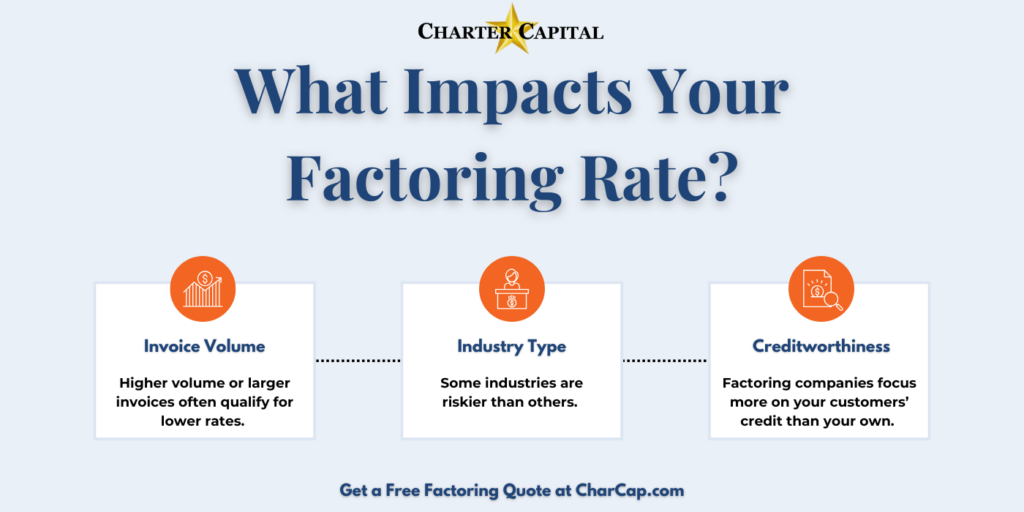
- What Drives Your Rate: Your customers’ creditworthiness, your monthly invoice volume, and your industry type are the three main factors.
- No Hidden Fees: Charter Capital charges no ACH fees. Setup fees are waived. All costs are clearly disclosed in your factoring agreement.
- Rate Structures: We offer both flat-rate and tiered factoring fee structures depending on your business needs.

Invoice factoring cost at Charter Capital starts as low as one percent of your invoice value, with competitive rates tailored to your business volume, industry, and customer creditworthiness. Unlike many factoring companies, Charter Capital offers transparent pricing with no hidden fees, waived origination fees, free transfers, and flexible terms designed to maximize your cash flow. Our invoice factoring cost structure is straightforward and cost-effective, ensuring that the service more than pays for itself through improved business growth and financial stability.
How Much Does Invoice Factoring Cost?
At an industry level, invoice factoring fees typically range from one to five percent of the total invoice value. At Charter Capital, most businesses with strong customers and regular invoice volume qualify for rates between one and three percent. The exact rate depends on three factors: the volume of the invoices you factor each month, your customers’ payment history and creditworthiness, and the total dollar value of the invoices being factored.
Factoring Rate by Invoice Volume (Typical Ranges)
| Monthly Invoice Volume | Typical Rate Range | Notes |
| Under $50,000 | 3.0% – 5.0% | Smaller volumes, newer businesses |
| $50,000 – $150,000 | 2.0% – 3.5% | Most small businesses fall here |
| $150,000 – $500,000 | 1.5% – 2.5% | Established volume, lower risk |
| $500,000+ | 1.0% – 1.75% | High volume, negotiated rates |
The cost of invoice factoring is dependent on multiple factors. While the service isn’t free, it’s important to note that opting for the “cheapest” factoring companies often means sacrificing quality of service. Charter Capital offers competitive rates with a commitment to excellent service, ensuring that when used properly, invoice factoring can more than pay for itself. Typically, factoring fees and rates are much lower than the interest you would pay to an online lender or cash advance company. The idea is to have cash on hand for essential business functions rather than chasing customers and waiting for payment on their unpaid invoices.
The typical factoring cost is a few percent of the invoice amount, depending on several components such as:
- Volume: The volume of factored invoices.
- Time: How long it takes your customers to pay.
- Amount: The total dollar value of the invoices is to be factored monthly.
Some of our factoring fees are as low as one percent. Regardless, when you use Charter Capital, your business’s growth should more than offset the factoring costs, thanks to our focus on providing outstanding service and competitive rates.
Understanding the Advance Rate
When you factor an invoice, Charter Capital does not advance the full amount immediately. Instead, we advance a percentage. This is typically 90 percent of the invoice value, though it can be up to 98 percent. It’s deposited directly into your bank account within 24 hours. The remaining balance (the “residual”) is held until your customer pays the invoice in full. At that point, we release the residual to you, minus the factoring fee.
The advance rate varies based on the industry you operate in and the creditworthiness of your customers. Industries with reliable payment histories, such as staffing, typically qualify for higher advance rates.
How to Calculate Your Factoring Cost: A Working Example
Let’s say your business has a $20,000 invoice from a creditworthy customer, and you factor it at a two percent rate with a 90 percent advance rate. The numbers would look like the chart below.
| Step | What Happens | Calculation | Amount |
| 1 | You submit a $20,000 invoice to Charter Capital | Invoice value | $20,000 |
| 2 | Charter Capital advances 90% to your bank account | $20,000 × 90% | $18,000 sent to you |
| 3 | The 2% factoring fee is calculated on the full invoice | $20,000 × 2% | $400 fee |
| 4 | Your customer pays in full (e.g., within 30 days) | Full invoice paid | $20,000 sent to Charter Capital |
| 5 | Charter Capital releases the residual minus the fee | $20,000 – $18,000 – $400 | $1,600 sent to you |
| Total | $18,000 upfront + $1,600 on settlement = $19,600 total received | Total factoring cost | $400 (2% of $20,000) |
How Do You Know Charter Capital is the Right Company for You?
Charter Capital is a factoring firm that can help small and medium-sized businesses keep their cash flowing. We provide the business funding your company needs at rates that offer great value without cutting corners in service.
Flat vs. Tiered Rates: Which Structure is Right for You
Factoring Companies generally offer two types of fee structures. Understanding the difference helps you choose the right arrangement for your business.
| Flat-Rate Factoring | Tiered-Rate Factoring | |
| How it Works | A fixed percentage is charged regardless of how long the invoice remains unpaid. | The fee increases the longer the invoice remains unpaid (e.g., 1.5% for 0-30 days, then 0.5% per additional 15-day period). |
| Best For | Businesses that want to predetermine their fee and net margin. | Businesses where some customers pay quickly and others take longer, as it provides flexibility and rewards businesses with quick-paying customers. |
The Role of the Creditworthiness of a Client’s Customer Accounts in Invoice Factoring Rates
One of the most overlooked factors in determining your invoice factoring rate is the creditworthiness of your customers. While many assume that factoring companies base approval and pricing on the business owner’s financial history, that’s rarely the case. Since invoice factoring involves advancing funds based on your accounts receivable, the factoring company is primarily concerned with how likely your customers are to pay their invoices on time. The stronger your customers’ payment history, the lower the risk, and the better your potential rate.
This is especially important when comparing recourse and non-recourse factoring options. In non-recourse arrangements, the factoring company assumes the risk of non-payment, which may increase factoring costs and reduce the amount of credit that the factor will extend to some of your higher risk customers.
When choosing a factoring company, consider how they assess customer credit and how it affects both the advance rate and the percentage of the invoice you’ll retain. The right factoring partner will help you understand this process clearly, ensuring the rate reflects the actual risk, not just a flat fee.
The Hidden Factors That Influence Your Factoring Fee
While the cost of factoring is often quoted as a flat percentage, the final fee is nuanced. Beyond invoice volume and payment terms, several hidden variables can influence what factoring companies charge.
One significant factor is the invoice value concentration. If your business relies heavily on a small number of clients, your risk profile increases. Factoring companies may raise rates in these situations because a default from just one client can have a major impact on your cash flow and theirs.
Industry type also affects pricing. For instance, freight factoring for trucking companies tends to be priced differently than factoring for manufacturing or staffing.
What Other Fees Should You Know About?
Beyond the factoring rate itself, some factoring companies charge additional fees. Below, we’ll cover what to look for and how Charter Capital handles each one.
| Fee Type | What it Is | Charter Capital’s Position |
| Setup / Processing Fee | One-time fee to open your account, often $500 to up to a few thousand dollars. | Fees are waived. |
| ACH / Wire Transfer Fee | Charged each time your funds are sent to your bank. | No transfer fees via ACH; wire transfers are also available. |
| Early Termination Fee | Penalty for exiting before the contract term ends. | Easy notice termination. |
| Collection / Customer Service Calls | An additional charge for customer contact to obtain pay status and resolve payment issues when needed. | No additional charge for collecting payment remittances. |
| Minimum Volume Fee | Penalty if you fall short of a required monthly invoice volume. | Minimums are rarely applied. |
How Charter Capital Compares
| Feature | Charter Capital | Typical Factoring Companies |
| Factoring Rate | 1% – 3% of invoice value | 2% – 5% (industry standard) |
| Setup Fee | Waived | $500 to several thousand dollars common |
| Monthly Minimum | Rarely required | Often required |
| Contract Lock-In | Easy notice termination | Annual contracts with difficult termination provisions common |
| Advance Rate | 90% – 98% typical | 70% – 90% typical |
| ACH / Wire Fees | No fees for ACH transfers. | $25 – $35 per transfer common |
How Invoice Factoring Works When You Choose the Right Factoring Company
At Charter Capital, the entire factoring process is very simple. Your first step is to contact us. Give us a call or fill out our online application. This process should take you just a couple of minutes, and we will be able to contact you with pricing in less than 24 hours. Once we have set you up with a Charter Capital factor line, obtaining cash for your accounts receivable takes less than 24 hours and is easy.
- Serve Your Customers: You continue to provide your service or product to your customers just as you always have.
- Invoice Customers: You continue to invoice your customers as always.
- Submit Invoices: You send the invoices that you want to factor to Charter Capital, along with our simple factor form.
- Receive Advance: We send funds via ACH or wire directly into your bank account, usually in 24 hours or less.
- Receive Residual: We wait for your customer to pay us and notify you on the same day we receive payment.
- Repeat as Needed: You continue to grow your business without cash-flow worries.
Benefits of Doing Business with Charter Capital
Charter Capital’s competitive rates and excellent service mean that you can avoid many of the limitations placed on your business by traditional lenders and financing methods. Moreover, we allow you to grow your business without selling equity or giving up control of your company. To find out more about our invoice factoring services or to learn what your factoring fees will look like, request a free rate quote.
Frequently Asked Questions About Factoring Costs
How is the factoring fee calculated?
The factoring fee is calculated as a percentage of the full invoice value, not the advance amount. For example, if you have a $10,000 invoice and a two percent rate, the fee is $200 regardless of whether the advance rate is 90 or 98 percent.
What is a typical factoring rate for small business?
Most small businesses with reliable customers and consistent invoice volume qualify for rates between one and three percent. Rates above three percent typically apply to newer businesses, lower volumes, or industries with slower customer payment cycles.
Are there hidden fees in factoring agreements?
Unlike many factoring companies, Charter Capital’s fees are very clear and transparent. Your charge is the discount fee on the invoices you choose to factor. We do not require you to factor all of your invoices, and there are no processing fees for non-factored invoices. Unlike many of our competitors, there are no minimum charges for smaller invoices. Nor do we charge to transfer funds to you by ACH. Please reach out to one of our business development officers for more information.
Can I negotiate my factoring rate?
Yes. Rates are negotiable, especially if you factor high invoice volume, your customers have strong payment histories, or you are willing to commit to a longer term. Speak with a Charter Capital account manager to discuss your specific situation.
